The Jews of Halberstadt
A Community History in European Context, 1261–2026
August 2026
Table of Contents
Abstract
For roughly seven centuries a Jewish community lived, and intermittently did not live, in the small episcopal city of Halberstadt in the northern Harz foreland. Its documented history opens in 1261 with a grant of protection whose wording already implies an earlier presence, and it ends — as an unbroken communal history — on the November night in 1938 when the Baroque synagogue of 1712 was gutted, and in the spring and autumn of 1942 when the remaining members were deported. Between those points the community was expelled twice, readmitted twice, destroyed by war, rebuilt under a mercantilist prince, and raised by a single court Jew into one of the most consequential centres of Jewish learning in the German lands. In the nineteenth century a town of fewer than thirty thousand people produced both Israel Jacobson, conventionally named the father of Reform Judaism, and Esriel Hildesheimer, the institutional architect of modern Orthodoxy — the two poles of the century’s central Jewish argument, born a mile apart and fifty-two years apart.
This paper reconstructs that history as a case study in a general problem: how a legally protected, fiscally exploited, and structurally expendable minority negotiated survival under divided sovereignty, and what happened when the machinery of the modern state replaced the machinery of the medieval one. It is written for the Reichenbach Family Archive, whose own record — a clothing business founded in Halberstadt in the mid-nineteenth century, and the losses and restitution that followed — occupies the final century of this narrative. Two claims preserved as family tradition are identified as such and flagged for documentary testing rather than absorbed into the argument.
The paper proceeds chronologically in seven parts, with excursus panels that place the local record inside two wider frames: the political and confessional history of Europe, and the internal history of Jewish civilisation. It closes with a chronology, an annotated guide to further reading, and a practical guide to the archives in which the family’s own documentation can be pursued.
A note on sources, method, and evidentiary standing
This is a work of synthesis, not of original archival research. It rests on published reference works, the scholarly monograph literature, museum and memorial documentation, digitised nineteenth-century sources, and — for the present day — the German press and the publications of state bodies. Where a claim rests on a single source, the note says so. Where sources conflict, the conflict is reported rather than resolved by silent preference.
Three cautions govern what follows.
First, on the reference literature. Much of the accessible detail for Halberstadt descends from two encyclopaedia entries: the article in the Jewish Encyclopedia of 1901–06, and Zvi Avneri’s article in the Encyclopaedia Judaica.1 Both are compressed, and both draw ultimately on Benjamin Hirsch Auerbach’s community history of 1866 — written by a serving rabbi of the community about his own congregation.2 That genealogy of knowledge should be borne in mind: several figures that circulate as established fact are, on inspection, a single nineteenth-century statement repeated. The standard modern scholarship — above all Berndt Strobach’s biography of Berend Lehmann, Beate Reupke’s study of the community’s school, and Philipp Graf’s account of Jewish Halberstadt under East German rule — has corrected and deepened this inherited picture, and is cited here in preference wherever it reaches.
Second, on numbers. Pre-modern communal statistics are administrative artefacts: they count taxable households, protected persons, or burials, not populations. Where this paper gives a figure it names the unit being counted. The most consequential correction made here concerns the number of Halberstadt Jews murdered in the Shoah; see §7.3 and note 3.
Third, on family tradition. Two elements of the Reichenbach Archive’s own memory appear below — the employment of Eastern European Jews in the Halberstadt dairy trade, and the family’s non-religious, liberal orientation within an Orthodox town. Both are historically plausible and both are typical of their period. Neither is here corroborated by documents. They are presented as testimony, marked as such, and accompanied in Appendix C by the specific record series that would test them.
Translations from German are the author’s unless otherwise noted. Hebrew and Yiddish terms are transliterated in a general-reader style rather than a scholarly one, except in the titles of cited works.
1. Introduction: The Problem of Halberstadt
1.1 A city under two masters
Halberstadt lies in the foreland of the Harz mountains, in what is today the German federal state of Saxony-Anhalt. For most of the period covered here it was not an ordinary town but the seat of a prince-bishopric: a territory governed directly by its bishop, who held temporal authority as an imperial prince and answered, in spiritual matters, to Rome. That constitutional fact organises everything that follows.
Divided sovereignty made Halberstadt’s Jews the object of a permanent jurisdictional contest. The bishop claimed them; the cathedral chapter had interests of its own; and the city council, whose economic interests frequently ran contrary to the bishop’s fiscal ones, claimed them too. Each party asserted the right to tax, to protect, and to profit. The surviving medieval record accordingly shows the community less as a society than as an asset in litigation — a fact of documentation that has shaped, and distorted, every history written since. It is worth stating plainly at the outset that the archival silence about ordinary Jewish life in medieval Halberstadt is a silence of record-keeping, not of existence.
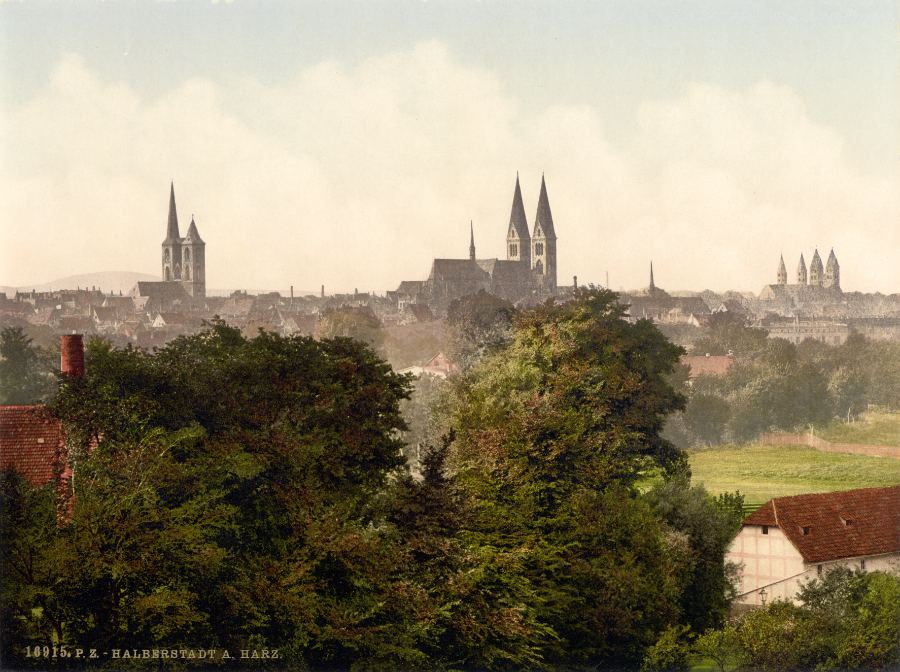
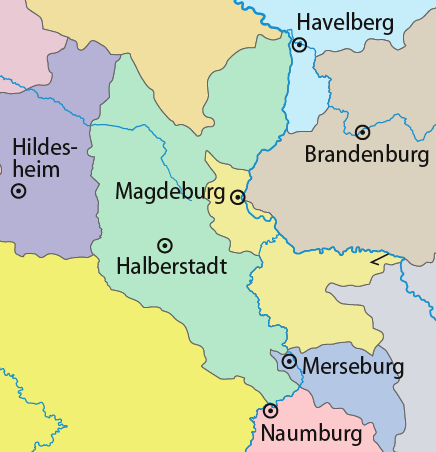
Out of this precarious arrangement grew something unexpected. By the turn of the eighteenth century Halberstadt housed one of the largest Jewish communities in Central Europe; at its height Jews are estimated to have constituted close to a tenth of the town’s inhabitants.4 In the nineteenth century the town became the acknowledged centre of German Neo-Orthodoxy — a place of celebrated rabbis, Hebrew printing presses, industrialist-philanthropists, and, until 1930, the seat of the central organisations of German Orthodox Jewry.5 It was also the town in which, in the mid-nineteenth century, Jacob Reichenbach founded the clothing business that grew into a family of stores in Halberstadt and beyond.
1.2 The mechanism: credit, protection, and expendability
One structural pattern recurs so persistently in this history that it deserves to be named before the narrative begins.
Medieval canon law prohibited Christians from lending money at interest to other Christians. Yet a growing economy of towns, fairs, wars, and cathedral-building ran on credit. Jews, excluded from landholding, from the craft guilds, and from most professions, were channelled toward the economic functions Christian law left open to them: moneylending and trade. Bishops, princes, and emperors quickly grasped the advantages. Jews could be admitted under letters of protection, taxed heavily for the privilege of residence, squeezed for extraordinary levies whenever the treasury required it, and treated in law as the ruler’s personal property — servi camerae, serfs of the imperial chamber.
The same arrangement made them permanently expendable. When debts fell due, when harvests failed, when plague arrived, or when a ruler needed popular anger redirected away from his own court, the community that had served as the realm’s financial sponge could be wrung out and discarded: debts extinguished by expelling the creditors, property confiscated, mobs permitted or encouraged to do what the ruler preferred not to order openly. Expulsion was not merely an expression of prejudice; it was fiscal policy and political theatre. Halberstadt’s Jews lived inside this mechanism for five centuries, and most of the turning points below are a turn of its wheel — until, in the twentieth century, the machinery of the modern state converted it into something categorically worse.
1.3 A necessary corrective: the myth of the Jewish moneylender
A caution belongs here, so that this paper does not reproduce the very stereotype it sets out to analyse.
The most important recent revision of this field is Julie L. Mell’s The Myth of the Medieval Jewish Moneylender, which demonstrates that the identification of medieval Jews with moneylending is substantially an artefact of the sources rather than a description of the economy.6 Most medieval Jews were not lenders. The majority were poor, working as pedlars, artisans, servants, and petty traders; in many communities only a minority ever extended credit, and in some the lending sector was a handful of households. The “Jewish usurer” was a legal and fiscal category imposed from above, and a cultural fantasy sustained from below, far more than it was an occupational reality.
The mechanism described in §1.2 is therefore real, but it must be stated with precision: it describes how rulers and mobs used the association of Jews with money, not what most Jews did for a living. The point is not merely methodological. It has a direct evidentiary consequence for Halberstadt, because the town has produced one of the rare survivals that lets us see past the fiscal record to ordinary Jewish commerce — the business ledger of the wool trader Isaak Melcher, sealed in a house wall and recovered in 2015 (§5.3). Melcher, not Berend Lehmann, is the representative figure.
2. The Medieval Community, 1096–1493
2.1 Before the record: the shadow of 1096
No Jew is documented in Halberstadt in the eleventh century, but the world such a Jew would have entered was made then. In 1096, as the First Crusade assembled, mobs of crusaders and townsmen destroyed the Jewish communities of the Rhineland — Speyer, Worms, Mainz, Cologne — in the events Jewish memory calls the gezerot tatnu, the decrees of the Hebrew year 4856. Thousands died. Many communities chose martyrdom, kiddush ha-shem, over forced baptism. These massacres are conventionally taken to open the long era of organised anti-Jewish violence in Europe, and they established the pattern that would define Ashkenazi life for centuries: Jewish communities depended for survival on the protection of bishops and emperors — protection that was real, purchasable, revocable, and sometimes simply overwhelmed.7
EXCURSUS: THE WIDER WORLD. The Crusades (1096–1291) reoriented Europe toward the Mediterranean and the Holy Land, and each new campaign brought fresh waves of anti-Jewish violence at home. The era of the great crusades ended with the fall of Acre in 1291; the theological image of the Jew as the enemy within, forged in crusade preaching, long outlived the campaigns themselves.
EXCURSUS: THE JEWISH WORLD. The same soil produced a golden age of learning. Rashi of Troyes (1040–1105), who had studied in the Rhineland academies of Mainz and Worms, completed his commentaries on the Bible and Talmud in the very generation of the massacres; his grandsons and their students, the Tosafists, spent the following two centuries constructing the dialectical superstructure of Talmud study in France and Germany. Every page of Talmud studied in Halberstadt’s Klaus five hundred years later would be framed by Rashi on the inner margin and the Tosafot on the outer. Ashkenaz — the Jewish name for these German lands — was simultaneously a place of martyrdom and one of the great engines of Jewish civilisation: the memorial prayers composed for the crusade martyrs, such as the Av ha-Rachamim still recited on the Sabbath, entered a liturgy that Halberstadt’s synagogues would carry for eight centuries.
2.2 1261: Bishop Volrad’s letter of protection
The earliest surviving documentary evidence of Jews in Halberstadt is a grant of protection of 1261, issued in the episcopate of Volrad von Kranichfeld (bishop 1255–1296). Its significance lies less in the grant than in its wording: the Jews’ legal standing was to be upheld according to the town’s old custom — a formula implying that the community was already established and its arrangements already customary. The document therefore marks the beginning of the record, not of the settlement.8
Two refinements to the conventional account are worth registering. The instrument is generally described as the bishop’s letter, but it appears to have been issued by the bishop together with the city council — a joint act that anticipates the divided jurisdiction described in §1.1. And the phrase rendered by the Encyclopaedia Judaica as a promise of protection “as in the past” is the historically load-bearing element: it pushes the Jewish presence in Halberstadt back into an undocumented period, probably the early thirteenth century.
The Jewish quarter grew up close to the bishop’s own residence. Physical proximity to the protector was itself a survival strategy. In exchange for an annual fee the bishops guaranteed the right to live and do business in the town. Through the thirteenth and fourteenth centuries the scant surviving records show the Jews of Halberstadt chiefly as an object of litigation — a prize contested between bishop and council, each claiming jurisdiction over them and over the revenue they generated. In the eyes of the law they were less neighbours than assets.
EXCURSUS: THE WIDER WORLD. The thirteenth century hardened Jewish life across Europe. The Fourth Lateran Council of 1215 required Jews to wear distinguishing dress. The blood libel — the fantasy that Jews murdered Christian children for ritual purposes — spread from England across the continent, and a new accusation was born in this era: host desecration, the tale of Jews torturing the consecrated communion wafer.9 Such tales followed a script that ended, almost always, in the torture and killing of the accused and often of their entire community. England expelled its Jews in 1290; France followed in 1306. The direction of Jewish migration turned east — into the German lands and, beyond them, Poland.
EXCURSUS: THE JEWISH WORLD. The libels had a history of their own, and Germany stood near its centre. The first ritual-murder accusation in Europe was invented at Norwich in 1144. In 1190, amid Third Crusade fervour and resentment of debts owed to Jewish lenders, the Jews of York took refuge from a mob in Clifford’s Tower, the royal keep; besieged and offered only baptism or death, most of the roughly one hundred and fifty people inside died by their own hands, and those who surrendered were killed anyway. The practical postscript tells the underlying story: the mob’s leaders marched to York Minster and burned the records of their debts. In 1235, at Fulda — barely a hundred miles from Halberstadt — thirty-four Jews were killed on a blood-libel charge, prompting Emperor Frederick II to convene an inquiry of learned converts which formally pronounced the accusation baseless. It made little difference: the libel resurfaced for centuries, most infamously at Trent in 1475 and as late as Damascus in 1840.
The same era attacked the books along with the people: in 1240 the Talmud was put on trial in Paris, and in 1242 cartloads of Talmud manuscripts were burned in the Place de Grève. These were also the years of the great Maimonidean controversy — the battle over whether Maimonides’ philosophical rationalism (the Guide of the Perplexed, c. 1190) was the crown of Torah or a danger to it, a dispute so fierce that rival camps of rabbis in the 1230s denounced each other’s books, and some later linked the Paris burnings to heaven’s displeasure at the quarrel. Ashkenaz largely held to its Tosafist path, but the argument between reason and tradition never really ended; Halberstadt’s nineteenth-century Neo-Orthodoxy is a late and sophisticated round of it.
2.3 1348–1351: the Black Death and a significant silence
When plague killed perhaps a third of Europe, the search for someone to blame settled on the Jews, accused of poisoning wells. From 1348 to 1351 community after community was annihilated: in Basel, Jews were burned alive in a wooden structure on a Rhine island; in Erfurt, not far from Halberstadt, and in Frankfurt and Toulon and dozens of other towns, mobs murdered their Jewish neighbours. In Strasbourg, on 14 February 1349, the entire community — contemporaries claimed two thousand people — was publicly burned before the plague had even arrived in the city, in an act entangled with a guild revolt and with the convenient erasure of debts owed to Jewish lenders.
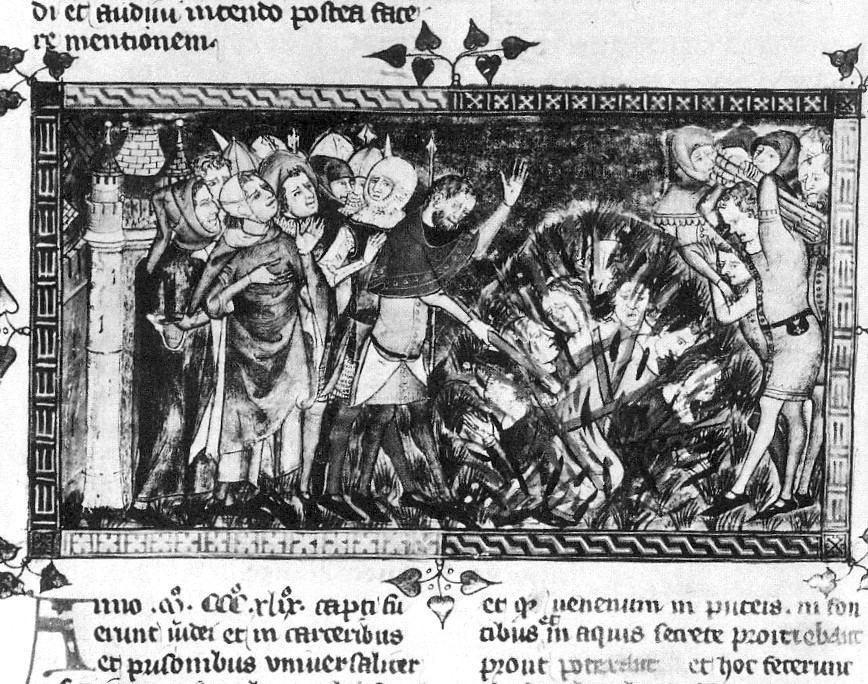
Against this background Halberstadt presents an anomaly that deserves careful statement, because it is frequently overstated. In their study of the persistence of antisemitic violence in German localities, Nico Voigtländer and Hans-Joachim Voth note that in Halberstadt “transactions with Jewish money lenders are recorded right before and during the Black Death; there is no record of any violence.”10 Halberstadt is in fact the only town for which they supply this particular evidence, and their underlying authority is the Germania Judaica — that is, German local historiography, not an economic dataset. The claim should be cited accordingly.
Certainty is impossible at this distance. Absence of a record of violence is not the same as a record of absence of violence, and the medieval documentation for Halberstadt is thin. The most defensible reading is that Halberstadt’s Jews appear to have been spared the fate of many neighbouring communities, whether through the bishop’s protection, the town’s particular politics, or contingency.
What makes the anomaly genuinely interesting is that it runs against the statistical grain. Theresa Finley and Mark Koyama, analysing persecution across the Holy Roman Empire, find that “communities governed by Archbishoprics, Bishoprics, and Imperial Free Cities experienced more intense and violent persecutions than did those governed by the emperor or by secular princes.”11 Their proposed mechanism is political fragmentation and competition over the rents generated by Jewish moneylending, together with contested authority between bishops and cathedral chapters — not clerical religious hostility as such. Halberstadt, an episcopal seat, therefore sat squarely in the high-risk category and nevertheless appears to have escaped. The town is an exception to a well-evidenced regularity, and it should be presented as a puzzle rather than as a happy ending.
EXCURSUS: THE WIDER WORLD. The Black Death pogroms of 1348–51 triggered one of the great migrations of Jewish history: survivors streamed eastward into Poland and Lithuania, whose rulers offered charters of protection. The demographic centre of Ashkenazi Jewry began its long shift from the Rhineland and central Germany toward Eastern Europe — a movement whose eventual return westward, five centuries later, is the subject of §6.4.
2.4 1364 and 1456: a community in view
A Jewish settlement — a Judendorf — possessing its own synagogue is first explicitly mentioned in Halberstadt in 1364. By 1456 the records count eleven Jewish families, occupied mainly in moneylending.12 By the middle of the fifteenth century the community appears to have been stable, organised, and economically significant: small in numbers, but established.
Both dates require the caveat entered in §1.2. “Eleven families, occupied mainly in moneylending” is a description of a taxable population as recorded by an authority interested in credit. It is not a census, and it is not an occupational survey.
2.5 1493: expulsion
The community’s fifteenth-century stability ended by decree. In 1493 Ernst of Saxony — Archbishop of Magdeburg from 1476 and, by papal dispensation, administrator of the see of Halberstadt from 1480 — expelled the Jews from his territories.13 A presence documented in the town for at least 232 years, and in practice longer, was uprooted.
The edict fits the mechanism precisely: a prelate consolidating power across two jurisdictions, a population whose debts to Jewish lenders vanished along with the lenders, and a Europe in which the expulsion of Jews had just been demonstrated, spectacularly, as an instrument of state.
EXCURSUS: THE WIDER WORLD. The timing was not an accident of local history. One year earlier, in 1492, Ferdinand and Isabella’s Alhambra Decree expelled the Jews of Spain — the largest and most catastrophic expulsion of the age, ending the greatest Jewish community in the world. Portugal followed in 1497 with expulsion and mass forced conversion. Tens of thousands of Sephardic refugees scattered across the Mediterranean. The Ottoman Empire, then rising toward its zenith — Constantinople had fallen to Mehmed II in 1453 — opened its ports to them; Sultan Bayezid II is famously said to have marvelled that the Spanish king had impoverished his own realm while enriching the Ottoman one. Salonika, Constantinople, and Izmir became great Sephardic centres. Meanwhile, across the German lands, town after town expelled its Jews in the same decades. The Halberstadt edict of 1493 was one wave in a continent-wide tide.
3. Expulsion, Return, and War, 1493–1650
3.1 The sixteenth century: return and second expulsion
Within a few decades Jews were permitted to trickle back into Halberstadt, and by mid-century a small community existed again. It did not last. In 1594 or 1595 the Jews were expelled from the town a second time, by Heinrich Julius of Brunswick-Wolfenbüttel, administrator of the see from 1566 to 1613 — the same prelate who subsequently readmitted them, apparently in 1606.14
The pattern repeated once more: expulsion, cautious return, rebuilding. Several Jewish families settled again in Halberstadt and even built a synagogue. This rhythm is one of the deep signatures of Halberstadt’s Jewish history — a community repeatedly erased on paper that repeatedly declined to stay erased. It is also a reminder that early modern expulsion was frequently less a permanent settlement than a fiscal manoeuvre with a foreseeable reversal: the ruler who expelled a community and cancelled its credits generally discovered, within a generation, that he wanted the credit back.
EXCURSUS: THE WIDER WORLD. The Reformation had shattered Western Christendom. Luther, who early in his career had courted Jews as potential converts, published in 1543 one of the most venomous anti-Jewish tracts ever printed, urging that synagogues be burned and Jews expelled — a text Protestant territories would cite for centuries and the Nazis would gleefully republish. Confessional conflict between Catholic and Protestant states dominated the era and would soon explode into general war.
EXCURSUS: THE JEWISH WORLD. While Ashkenaz endured expulsion and return, the centre of Jewish creativity had shifted to the Sephardic diaspora — above all to Safed in Ottoman Galilee, where the exiles’ children built the most influential Jewish century since the Talmud. There Isaac Luria (d. 1572) recast Kabbalah around exile and repair — tikkun — a mysticism forged by a generation that had watched a Jewish world end. And there Joseph Karo completed the Shulchan Aruch, printed in 1565: for the first time, a single practical code of Jewish law for the whole people. When Moses Isserles of Kraków added his glosses — the Mapah, the “tablecloth” on Karo’s “set table” — recording Ashkenazi custom wherever it differed, the combined work became the operating system of traditional Jewish life everywhere. The families who returned to Halberstadt after 1595 ordered their kitchens, their Sabbaths, their marriages, and their courts by it; the community’s later fame as a bastion of halakhic Judaism is, at bottom, fidelity to this book.
3.2 1618–1648: the Thirty Years War and the end of the prince-bishopric
The synagogue built by the returning families did not survive the century. It appears to have been destroyed in a mob attack in 1621, during the currency chaos of the Kipper- und Wipperzeit, when money-changers were a natural target for popular fury; the reference literature more loosely dates its destruction to the Thirty Years War, the conflagration that devastated the German lands more thoroughly than any conflict before the twentieth century.15
Armies crossed and recrossed the region; some German territories lost a third or more of their population to violence, famine, and disease. For Halberstadt, the war’s end brought a transformation of the deepest constitutional kind. The Peace of Westphalia in 1648 secularised the prince-bishopric. The bishop’s territory became the Principality of Halberstadt and was granted to Frederick William, Elector of Brandenburg — the rising Hohenzollern state that would become Prussia — as compensation for Western Pomerania ceded to Sweden. After four centuries under crozier and mitre, Halberstadt’s Jews would now deal with the Great Elector in Berlin.
The change of master mattered more than a change of confession would have. A prince-bishop’s interest in Jews was fiscal and local; a mercantilist elector’s interest was fiscal and strategic. That difference produced the community’s rebirth.
EXCURSUS: THE WIDER WORLD. The Thirty Years War (1618–48) began as a religious conflict and ended as a struggle of states; the Peace of Westphalia that closed it is often taken as the birth of the modern European state system. For Jewish history the war mattered doubly: the devastation created ruined treasuries and desperate armies whose financing needs opened the door to a new figure — the court Jew — and the same years saw the Khmelnytsky massacres of 1648–49 annihilate hundreds of Jewish communities in Ukraine, sending shock and refugees westward.
4. Rebirth under Brandenburg-Prussia, 1650–1730
4.1 1650 and 1661: the Great Elector opens the door
In 1650 ten Jewish families were granted privileges by the new Brandenburg authorities allowing them to live in Halberstadt and to engage in business and moneylending — while pointedly forbidding them to build a synagogue.16 In 1661 the community received the right to elect its own rabbi.
The Great Elector, Frederick William, was a mercantilist. He admitted Jews to Brandenburg’s towns not out of tolerance but out of calculation, convinced that Jewish merchants and financiers would enrich his war-ruined territories. The calculation was correct. The authorities protected the newcomers against the resentment of Christian merchants, and the community grew rapidly — to 118 families, some 639 persons, by 1699, and roughly 120 families in the years around 1700. A burial society founded in 1679 — the chevra kadisha — would still exist two and a half centuries later.17
The prohibition on a synagogue is not an incidental detail. It is the hinge on which the next two decades turn.
EXCURSUS: THE WIDER WORLD. The mid-seventeenth century saw mercantilist rulers across Europe invite Jews back for economic reasons: the Great Elector in Brandenburg, and — at the urging of the Amsterdam rabbi Menasseh ben Israel — Oliver Cromwell in England, where Jews were readmitted in the 1650s after some 360 years of banishment. Utility, not tolerance, was the motive; but utility built communities that tolerance later inherited.18
EXCURSUS: THE JEWISH WORLD. These were also years of trauma and fever. The Khmelnytsky uprising of 1648–49 — gezerot tach ve-tat, the evil decrees of those Hebrew years — destroyed hundreds of Jewish communities in Ukraine and Poland, a catastrophe Jewish memory ranks with the worst before the twentieth century. Chronicles such as Nathan of Hanover’s Yeven Metzulah (“Abyss of Despair”) recorded the horrors; the fast of the twentieth of Sivan was renewed in mourning; and refugees and ransom appeals moved west through communities like Halberstadt for decades.
Into that wound stepped Shabbetai Zvi of Izmir, proclaimed messiah in 1665. The frenzy was universal: in Germany, Poland, Amsterdam and beyond, Jews fasted, did penance, sold property, and packed for the Land of Israel; sober merchants wrote the “messianic year” into their ledgers. In September 1666, given by the Ottoman sultan the choice between death and Islam, the messiah converted — and the deepest disillusionment in early modern Jewish history followed. The rabbinate spent the next century hunting secret Sabbatianism (the Emden–Eybeschütz controversy of the 1750s convulsed Germany over exactly this), and communal energy turned deliberately inward, toward law, order, and study. Institutions like Lehmann’s Klaus, endowed a generation after the debacle, embodied that turn: build houses of study, not castles in the air.
4.2 18 March 1669: the mob, the military, and the hammer
The prohibition on synagogues did not stop the community from worshipping, and tension with the townspeople simmered. On 18 March 1669 it broke. Seizing on a legal pretext, a crowd — aided, remarkably, by soldiers — demolished the community’s synagogue on the Judenstrasse. One detail survived the centuries with eerie precision: the hammer used to force open the synagogue doors was kept as a trophy and preserved in the parish house.19
What happened next is just as remarkable. The Jewish community sued the city of Halberstadt. The Elector, indignant at the mob’s high-handed action, allowed a formal investigation, and at its end the city was ordered to pay compensation to the Jewish community.20 In seventeenth-century Europe this was a rare and precious thing: a Jewish community winning legal redress against a Christian town for anti-Jewish violence.
The limits of that justice were equally telling. The Elector refused permission to rebuild the synagogue, instructing the Jews to hold services in their homes — which they did, for more than forty years. The episode is a compact illustration of the whole system: the ruler would defend his Jews against his subjects, because they were his; he would not concede them a public building, because that was a different order of recognition altogether.
4.3 1661–1730: Berend Lehmann and the making of a centre
Into this community came its most consequential figure. Issachar Berend Lehmann — known in the Jewish world as Issachar Bermann ha-Levi, and sometimes simply as Berman Halberstadt — was born in Essen in 1661 and rose to become banker, merchant, mint and army contractor, and diplomatic agent: a court Jew in the fullest sense.21
His patron was one of the most flamboyant princes of the age, Elector Augustus II “the Strong” of Saxony, who coveted the elective crown of Poland. Lehmann was entrusted with financing the campaign. He raised sums running into the millions of gulden by selling and pawning Saxon holdings and marshalling loans from Christian and Jewish banking partners, and the funds were deployed to win over the Polish electors. Augustus got his crown, and in 1697 the grateful king named Lehmann Resident of the King of Poland in the Lower Saxon Circle, with his seat in Halberstadt, where he lived as a Prussian protected Jew.
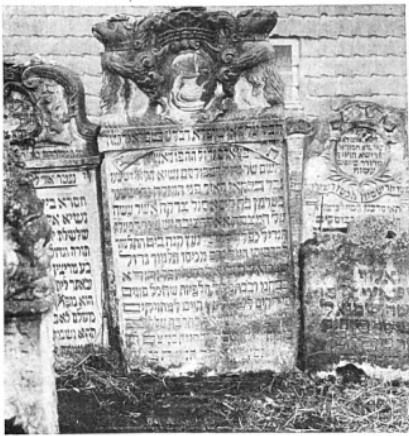
What makes Lehmann matter to Jewish history is what he did with his position. Between 1697 and 1699 he financed the first complete printing of the Babylonian Talmud on German soil, at Frankfurt an der Oder — a monumental twelve-volume edition still known as the “Bermann Talmud.” He is reported to have given away a substantial part of the print run free of charge to scholars and to communities in Eastern Europe devastated by the wars of the preceding half-century.22 In Halberstadt he established a bet midrash in 1689 that grew into the renowned Klaus, in its famous form by 1707 — a house of study whose scholars would make the town a centre of Torah learning for two centuries. And it was under his patronage that the community at last, in 1712, inaugurated a new synagogue.
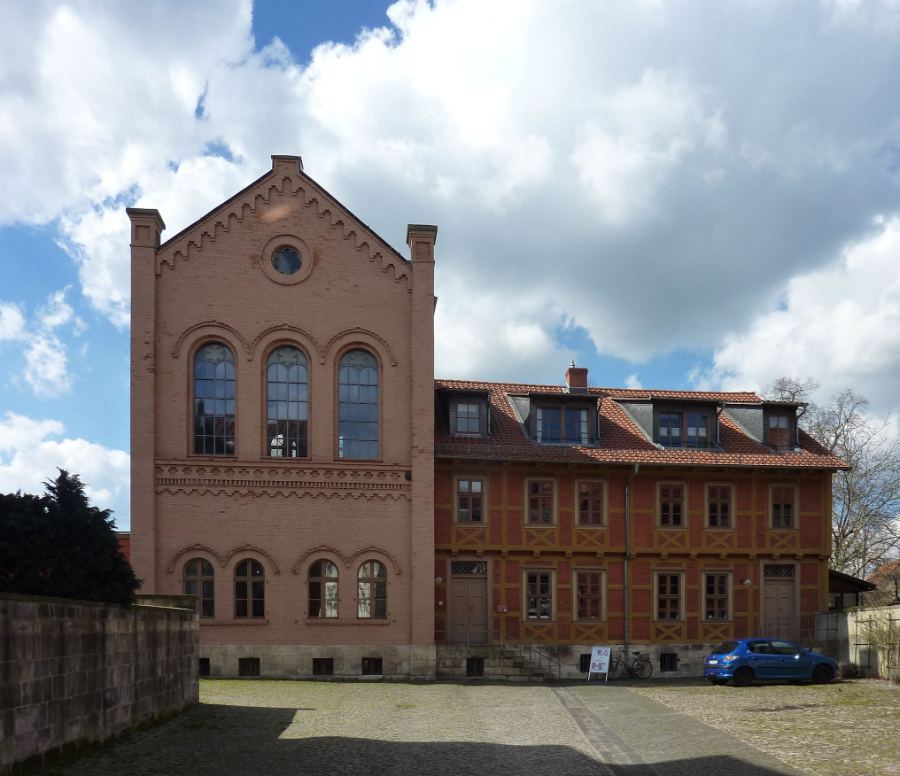
4.4 The synagogue of 1712
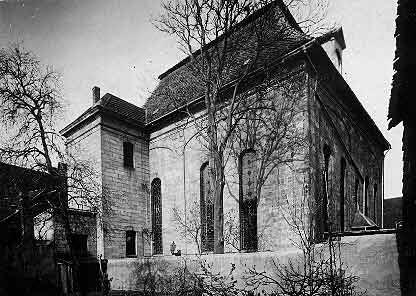
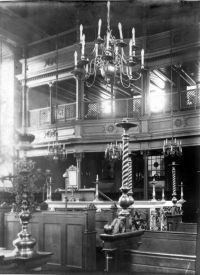
The Baroque synagogue Lehmann’s patronage made possible was, by the accounts that survive, extraordinary. It was hidden from the street behind the houses of Bakenstrasse and Judenstrasse — discretion remained the price of permission — yet its cupola nevertheless rose to twice the height of the surrounding buildings. It has been described as the first synagogue in Germany built to a deliberate architectural concept. It would serve Halberstadt’s Jews for 226 years, until November 1938.
Lehmann died in Halberstadt in 1730. Thanks in large part to his patronage, the town he adopted had become one of the largest and most learned Jewish communities in Central Europe.
EXCURSUS: THE WIDER WORLD. The age of the court Jews (roughly 1650–1750) was the paradox of early modern Jewish history. A handful of financiers — Lehmann, his kinsman Leffmann Behrends in Hanover, Samuel Oppenheimer and Samson Wertheimer in Vienna, and, most notoriously in memory, Joseph Süß Oppenheimer in Württemberg, judicially murdered in 1738 — wielded enormous influence while their communities remained rightless. Court Jews used their leverage to protect and endow Jewish life, but their position depended entirely on a single patron’s favour: the mechanism of usefulness and expendability, now operating at the highest level of the state.23
EXCURSUS: THE JEWISH WORLD. One voice lets us hear this world from the inside, and it is a woman’s. Glikl of Hameln (1646–1724), a Hamburg merchant’s wife widowed at forty-four with twelve children, carried on the family trade herself — dealing in pearls and gems, attending the Leipzig fairs, negotiating her children’s marriages into commercial and court-Jew families across Germany — and, beginning in 1691, wrote her memoirs in Yiddish for her children. Published only in 1896, and later translated into German by her descendant Bertha Pappenheim, they are the classic first-person account of the German-Jewish commercial world of exactly this era: the fairs, the dowries, the risks, the piety, the precariousness.24 Every Jewish trading family of the age — Halberstadt’s included, and in time the Reichenbachs’ own mercantile world — moved through the networks Glikl describes.
5. Learning, Taxation, and Emancipation, 1700–1871
5.1 The eighteenth century: a republic of scholars under a burden of taxes
The community’s rabbinical chair became one of the most distinguished in Germany. Zevi Hirsch Bialeh, called Harif (“the sharp one”), a scholar of renown brought to Halberstadt at the urging of Berend Lehmann’s circle, led the community from 1718 until his death in 1748, and under his direction the Talmud school flourished. Later incumbents included Hirschel Levin, who had previously served as chief rabbi in London and went on to Berlin; Löb Eger, appointed in 1775 and serving until his death in 1814; and Akiba Eger, from 1814 to 1824.25
A caution is essential here, because the confusion is common. The Akiba Eger who held the Halberstadt chair is not the celebrated Akiva Eiger of Posen (1761–1837), who never served in Halberstadt; the Halberstadt figure is Akiba Eger III (1767–1824), evidently the son and successor of Löb Eger.26
Prosperity of the spirit coexisted with fiscal servitude. The community groaned under debts contracted to meet extortionate taxation, which by 1794 amounted to some 2,500 thalers a year — even as it continued to fund its Talmud school and to send aid to poorer communities. In 1795 or 1796 it opened the Hascharath Zwi school for the children of poor families, an institution that would operate until the eve of the community’s destruction in 1942.27
5.2 Two Halberstadts: Jacobson and Hildesheimer
Here the town’s history springs its great surprise. The same small place produced both the founder of Reform Judaism and the institution-builder of modern Orthodoxy.
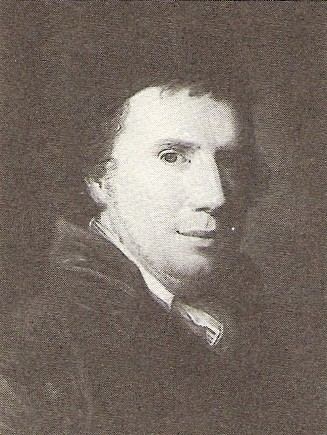
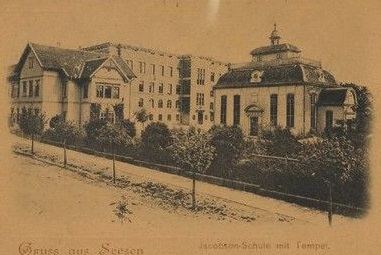
Israel Jacobson (1768–1828) was born in Halberstadt, the son of a merchant of the community this paper has been following. A financier who rose to serve the Brunswick court, Jacobson poured his fortune into a new vision of Jewish life: in 1801 he founded at Seesen a school educating Jewish and Christian boys together, and on 17 July 1810 he dedicated there, at his own expense, the temple usually counted the first Reform synagogue — with an organ, a choir, German hymns and sermons, and bells on the roof.28 Under Napoleon’s Kingdom of Westphalia — the same state that had just emancipated Halberstadt’s Jews — Jacobson served as president of the Royal Westphalian Consistory of the Israelites, the body that governed and modernised Jewish religious life in the kingdom, introducing confirmation ceremonies and regulated German-language worship. After Westphalia fell he moved to Berlin and held Reform services in his own home until the Prussian government shut them down. He died in 1828, decades before the movement he seeded conquered most of German Jewry — though never his own hometown.
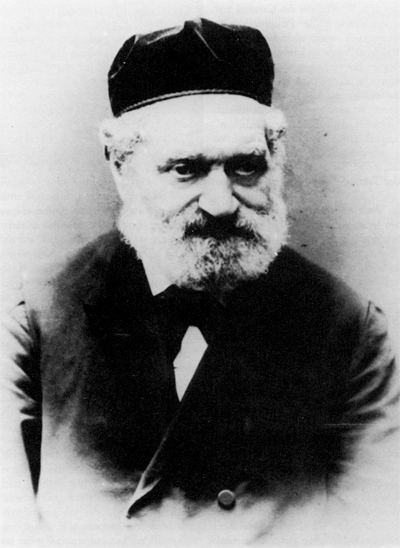
Esriel Hildesheimer (1820–1899) was born in Halberstadt fifty-two years after Jacobson, studied in its schools and its yeshiva world, took a university doctorate, and went on — as rabbi in Eisenstadt and then of Berlin’s secessionist Orthodox congregation Adass Jisroel — to found the Rabbinical Seminary of 1873 that trained generations of university-educated Orthodox rabbis.29 Jacobson and Hildesheimer are the two poles of nineteenth-century German Judaism, and both first opened their eyes on the same streets.
The town itself chose Hildesheimer’s pole. While in Frankfurt and Berlin the Orthodox had to secede from Reform-dominated communities under the Prussian Secession Law of 1876, in Halberstadt the battle ran in reverse: the official community itself remained Orthodox, and it was the acculturated and the religiously indifferent who formed the quiet minority within it.
5.3 1749: the book in the wall
For everything the chronicles record, almost no physical trace of ordinary Jewish daily life in Halberstadt survived the twentieth century — the museum long counted its material witnesses of the everyday on the fingers of one hand. Then, in 2015, during the restoration of a half-timbered house at Bakenstrasse 55, in Halberstadt’s lower town, the owners found a small book wrapped in rags, hidden in the wall between two layers of clay.30
Examined by Jutta Dick, director of the Moses Mendelssohn Academy, together with Uri Faber, the unassuming volume turned out to be the business ledger of a Jewish trader named Isaak Melcher, who dealt in woollen goods — stockings and caps — and recorded his sales in Hebrew script in his own hand. One entry is decorated with special care: a sale made at Purim, in keeping with the folk belief that doing business on Purim brings luck for the whole year — on that occasion, thick socks. Pinned and tucked among the pages were small pawn slips; on one of them Melcher certifies that a Johann Zabel redeemed his watch in 1749. Melcher appears in the Halberstadt Jewry lists of 1743–44 as a second-class protected Jew, aged seventy, married forty-two years, with four daughters. The ledger is now displayed in the permanent exhibition of the Berend Lehmann Museum.
What the book in the wall tells us is precisely what grand histories leave out. Here is the actual texture of Jewish economic life in eighteenth-century Halberstadt: not Lehmann’s millions but a small trader’s stockings and caps, petty pawnbroking alongside everyday retail, ordinary credit flowing between a Jewish trader and his Christian neighbours — Johann Zabel got his watch back — and Jewish religious culture woven into commerce itself, a Purim sale marked with joy. It is the perfect exhibit for the caution raised in §1.3: most Jews were Melchers, not Lehmanns. And for this archive it carries a particular resonance — a Halberstadt Jew making his living in textiles, a century before Jacob Reichenbach opened his clothing business in the same town. How the ledger came to be sealed in the wall, no one knows.
EXCURSUS: THE JEWISH WORLD. In Eastern Europe, meanwhile, Judaism was splitting along a new seam. Around the 1740s and 1750s, Israel ben Eliezer, the Baal Shem Tov (d. 1760), began teaching in Podolia a Judaism of joy, prayer, and the presence of God in ordinary life — Hasidism — which spread with astonishing speed through the shattered communities of post-Khmelnytsky Poland. Against it rose the greatest Talmudist of the age, Elijah of Vilna, the Vilna Gaon (1720–1797), whose bans on the new movement made “Hasidim and Mitnagdim” the fault line of Eastern European Jewry.
The same wounded landscape produced Sabbatianism’s last and darkest convulsion: Jacob Frank (1726–1791), who claimed Shabbetai Zvi’s mantle and led his followers into open war with rabbinic Judaism. Frankists instigated the disputation at Kamieniec in 1757, after which copies of the Talmud were burned by the cartload, and at the Lwów disputation of 1759 they pressed the blood libel against their fellow Jews — before following Frank into mass baptism into Catholicism. The episode seared into the rabbinic mind, German communities included, the danger of messianic enthusiasm run loose.
German Jewry, Halberstadt included, stood apart from both camps — its temperament closer to the Gaon’s scholarly rigour than to Hasidic ecstasy — and in a quiet tribute a century later, one of the works issued by Halberstadt’s own Hebrew presses was the Vilna Gaon’s Adderet Eliyahu. A third path was opening in Germany itself: Moses Mendelssohn’s Berlin circle and the Haskalah, which asked whether a Jew could stand fully inside both Torah and European culture. Halberstadt’s next century would be one long, considered answer.
EXCURSUS: THE WIDER WORLD. The Enlightenment was remaking the intellectual world. Moses Mendelssohn (1729–1786) — whose name the modern academy in Halberstadt bears — argued for Jewish civil inclusion and launched the Haskalah, the Jewish Enlightenment. In 1750 Frederick the Great’s General Ordinance grudgingly regularised the status of wealthy Jews in Prussia; in 1781 the Habsburg Joseph II issued his Edict of Tolerance; and in 1791 revolutionary France became the first European state to grant Jews full citizenship. The question of the age was posed openly for the first time: could Jews be citizens?
5.4 1806–1871: emancipation at bayonet-point, and its long repeal
Napoleon answered the question by force. After Prussia’s crushing defeat at Jena in 1806, Halberstadt was detached from Prussia and, in 1807, incorporated into the newly invented Kingdom of Westphalia under Napoleon’s brother Jérôme. In 1808 Westphalia became the first German state to emancipate its Jews, abolishing the special taxes, residence restrictions, and legal disabilities of the old order and declaring Jews citizens. For Halberstadt’s Jews — taxed and tolerated for five and a half centuries — the change was revolutionary, and its author was a foreign conqueror.
Prussia itself, reforming in defeat, issued its own Emancipation Edict in 1812 for its remaining territories. But when Napoleon fell and the Congress of Vienna redrew the map in 1815, Halberstadt returned to Prussia and the restoration rolled emancipation backward: rights granted were narrowed, promises deferred, and the “Jewish question” became the long-running argument of nineteenth-century German politics. Full legal equality arrived only with the North German Confederation’s law of 1869, extended to the whole new German Empire in 1871.31
EXCURSUS: THE WIDER WORLD. The Napoleonic Wars (1803–1815) carried the French Revolution’s principles across Europe in the baggage of its armies — civil equality, legal codes, the dismantling of ghettos in Italy and Germany — and the reaction after 1815 tried to stuff them back. The “Hep-Hep” riots of 1819 swept German towns as emancipation was debated and resented. The nineteenth-century German-Jewish experience — astonishing achievement shadowed by a new, racialised antisemitism — unfolded between those poles.
EXCURSUS: THE JEWISH WORLD. East of Prussia the century looked very different. In 1827 Tsar Nicholas I decreed Jewish conscription into the Russian army under the cantonist system: boys, officially from age twelve and in practice sometimes younger, seized by communal press-gangs to fill quotas, were sent to military schooling followed by twenty-five years of service, under relentless pressure to convert. The cantonist decades scarred Russian Jewry with a dread of the state that shaped everything after — including the readiness of millions to leave when the pogroms came.
In the German west, meanwhile, the grandson of rabbis on both sides became the century’s most consequential political thinker: Karl Marx, born in Trier in 1818 to a father who had converted to Protestantism to keep his legal career and had his children baptised. The Communist Manifesto appeared in the revolutionary year 1848. Jews shut out of the older elites were drawn in visible numbers to the new socialist movements — Marx, Ferdinand Lassalle, later Rosa Luxemburg and Leon Trotsky — and antisemites fused that visibility into the lie of “Judeo-Bolshevism,” which the Nazis would make a load-bearing pillar of their propaganda. That the overwhelming majority of Jews were neither socialists nor revolutionaries — and that Marx himself, in his 1844 essay on the Jewish question, wrote about Judaism with open contempt — made no difference to the myth.
5.5 The nineteenth century: capital of German Orthodoxy
Emancipation split German Jewry between Reform and Orthodoxy, and Halberstadt became the fortress of the traditionalists — but of a distinctly modern traditionalism.
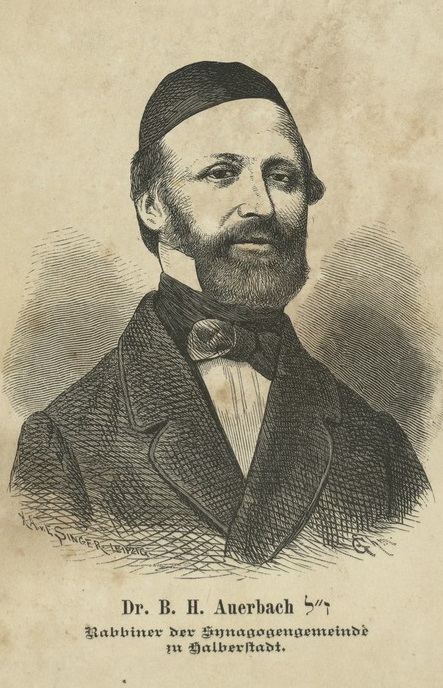
Rabbi Matthias Lewian is reported to have served from 1824 to 1862.32 He was followed by Benjamin Hirsch Auerbach (1863–72), a university-educated scholar and among the first Orthodox rabbis to preach in polished German, author of the history of the Halberstadt community (1866) on which so much later writing depends, and of a controversial edition of the medieval Sefer ha-Eshkol (Halberstadt, 1867–69).33 His son Selig Auerbach held the chair from 1872 to 1901, and the family held the rabbinate across four generations until 1938, the last incumbent being Zvi Benjamin Auerbach, rabbi from 1932, who emigrated to Palestine, founded the association of former Halberstadt Jews, and died in Tel Aviv in 1973.
Hebrew presses in the town printed prayer books and scholarly works in the 1850s and 1860s. The Hirsch family — industrialists in the metal trade — became famous for philanthropy, and late in the century financed the modernisation of Lehmann’s Baroque synagogue, adding a new entrance hall. The names associated with the town — Eger, Auerbach, Hildesheimer, Hirsch — made it one of the most important Jewish communities in central Germany.
EXCURSUS: THE JEWISH WORLD. Halberstadt’s stance only makes sense against the storm around it. Emancipation triggered the great modern argument over what Judaism should become: the Hamburg Temple of 1818 and Abraham Geiger’s Reform movement reshaped liturgy and doctrine for citizens of a modern state; Zacharias Frankel’s “positive-historical” middle way — the ancestor of Conservative Judaism — treated the law as binding but historically developed. When Frankel published his Darkhei ha-Mishnah, Halberstadt’s own Rabbi B. H. Auerbach stood publicly with the Orthodox critics who saw in it a denial of the law’s divine origin. The Orthodox answer was itself modern: Samson Raphael Hirsch’s Torah im Derech Eretz — full Torah observance joined to full European education — and Esriel Hildesheimer’s Rabbinical Seminary in Berlin (1873), which trained university-educated Orthodox rabbis.34 This Neo-Orthodoxy — German-preaching, secularly educated, halakhically uncompromising — found in Halberstadt its model community.
Meanwhile the Damascus blood libel of 1840 shocked emancipated Jewry into modern solidarity (Montefiore’s mission; the Alliance Israélite Universelle of 1860); the Russian pogroms after 1881 sent two million Jews westward and to America; and in 1897 Theodor Herzl convened the First Zionist Congress at Basel. Every option those movements created — America, Palestine, organised self-defence — would matter desperately to German Jews within two generations.
5.6 Mid-1800s: the Reichenbach thread
It was in this Halberstadt — emancipating, industrialising, self-confident — that Jacob Reichenbach (1844–1872) founded the family clothing business in the mid-nineteenth century. Over the following decades it grew into several stores dealing in ready-to-wear clothing, linens, and fashion wear in Halberstadt and beyond, including the nearby Harz town of Wernigerode.35
The family’s story — Jewish entrepreneurship rising with emancipation, woven into the commercial life of the town, and ultimately caught in the catastrophe that followed — is documented separately in the Reichenbach Family Archive. It belongs to, and personalises, every chapter of this paper’s final century.
6. The Age of Antisemitism, 1871–1933
6.1 1873–1899: hatred acquires a science and a name
Legal equality arrived in 1871; the backlash arrived with the stock-market crash of 1873. The Gründerkrach ruined small investors across the new Reich, and agitators supplied the culprit. In Berlin the court preacher Adolf Stoecker built a political movement on Jew-baiting. In 1879 the journalist Wilhelm Marr founded the League of Antisemites and gave the world the word itself — Antisemitismus, deliberately coined to sound scientific, racial, and modern rather than religious. The same year the eminent historian Heinrich von Treitschke made hatred respectable in the universities with the phrase “the Jews are our misfortune” — words Der Stürmer would later print on every front page. Houston Stewart Chamberlain’s Foundations of the Nineteenth Century (1899) supplied the pseudo-scholarly racial theory, and the fabricated Protocols of the Elders of Zion, concocted in Russia around 1903 and a German bestseller from 1920, supplied the world-conspiracy text.
The transformation matters structurally, and it is the pivot of this paper’s argument. For fifteen centuries a Jew could, at terrible cost, escape persecution through baptism. Racial antisemitism closed that door. Once Jewishness was blood rather than belief, there was no exit — the premise on which everything after 1933 was built.
6.2 1894–1906: the Dreyfus Affair
France, the first country to emancipate its Jews, produced the era’s defining scandal. In 1894 Captain Alfred Dreyfus, the only Jew on the French General Staff, was convicted of treason on forged evidence, publicly degraded — his epaulettes torn off, his sword broken, the crowd howling “death to the Jews” — and shipped to Devil’s Island. The affair split France for a decade; Émile Zola’s J’accuse…! (1898) made it the conscience of Europe; Dreyfus was pardoned in 1899 and fully exonerated in 1906.
Watching the degradation ceremony as a Viennese correspondent was Theodor Herzl — and the spectacle of emancipated France baying at a loyal Jewish officer pushed him to the conclusion of Der Judenstaat (1896) and the Basel Congress of 1897: if even France could do this, emancipation alone would never be safety.
6.3 The image of the Jew: from the Judensau to Jud Süß
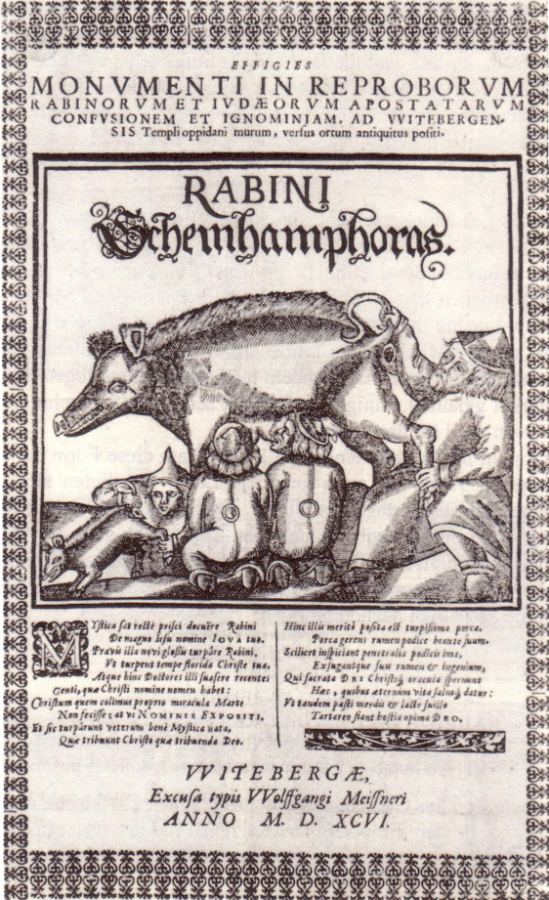
Antisemitism was always also a media phenomenon, and its imagery has a traceable pedigree. Medieval German churches carved the Judensau — Jews suckling from a sow — into their stonework; one still sits on the facade of the Wittenberg town church where Luther preached. Chaucer’s Prioress’s Tale (c. 1387) retailed the blood libel as entertainment; Shakespeare’s Shylock (c. 1596) gave the moneylender-as-Jew its most durable literary form, written for an England that had officially had no Jews for three centuries; the Grimms collected “The Jew Among Thorns” among their fairy tales; Dickens’s Fagin (1838) carried the figure into the modern novel — though Dickens, chastened by a Jewish reader’s letters, softened later editions and wrote the counter-portrait of Riah. From 1923 Julius Streicher’s Der Stürmer industrialised the caricature — the hooked nose, the money bag, the defiled maiden — down to children’s books such as Der Giftpilz (“The Poison Mushroom,” 1938).
The culmination came in 1940, and it reached back into this very history. Goebbels commissioned Veit Harlan’s feature film Jud Süß, a lavish character assassination of Joseph Süß Oppenheimer — the Württemberg court Jew judicially murdered in 1738, encountered in §4.4’s excursus — recasting the financier as extortioner and violator. The film inverted Lion Feuchtwanger’s sympathetic novel of 1925 and the sympathetic British film of 1934; some twenty million people saw it, and it was screened to SS units and camp personnel as motivational material. Its companion piece, Fritz Hippler’s pseudo-documentary Der ewige Jude (“The Eternal Jew,” 1940), intercut footage of Jews with swarming rats.
The Nazis did not invent their imagery; they inherited seven centuries of it, put it on celluloid, and aimed it. That the central film libel of the Third Reich was a court-Jew story — a moneylender story — shows how directly the medieval mechanism described in §1.2 fed the modern catastrophe.
6.4 The Ostjuden in Halberstadt: piety, dairy, and unease — a family memory
The pogroms and privations of the Russian Empire set Eastern European Jewry in motion, and Germany was both corridor and destination. A strictly Orthodox community like Halberstadt had particular use for the newcomers: a town that kept rigorous kashrut — including supervised chalav yisrael dairy production — needed reliably observant hands, and Hasidic and traditional Jews from the East supplied exactly that.
Family tradition preserved in the Reichenbach Archive holds that Eastern European Jews were employed in Halberstadt, especially in the dairy business, and that the Reichenbachs, like much of established German Jewry, regarded them with wary condescension, fearing that the newcomers’ foreignness would feed antisemitism and bring trouble down on the community.
That memory, uncomfortable as it is, is historically valuable, because it records from the inside one of the defining social fault lines of the age: the encounter between acculturated German Jews and the Ostjuden. Families that had spent a century earning emancipation — German-speaking, frock-coated, patriotic — often saw in the Yiddish-speaking, caftaned migrant a walking argument for the antisemites, even as German Jewry founded aid societies to feed, house, and move the migrants onward. The Easterners returned the judgment, finding German Judaism cold and diluted. Steven Aschheim’s Brothers and Strangers remains the classic study of this mutual regard, and treats it as central to modern German-Jewish history.36
The coda is bitter beyond words: the distinction the Reichenbachs’ generation drew meant nothing to the Nazis. The regime’s first mass deportation — the Polenaktion of late October 1938, in which some 17,000 Polish Jews were expelled from Germany and dumped at the border — targeted precisely the Ostjuden; among the expelled was the family of Herschel Grynszpan, whose despairing shooting of a German diplomat in Paris days later became the regime’s pretext for Kristallnacht.37 Within four years the machinery consumed Ostjude and Yekke alike.
Evidentiary status. The dairy-trade employment specifics rest on family testimony and deserve documentary follow-up. Community employment records and kashrut-supervision records, via the Moses Mendelssohn Academy and the Landesarchiv Sachsen-Anhalt, are the places to look. See Appendix C.
6.5 A second family memory: liberal Jews in an Orthodox town
Tradition in the Reichenbach Archive also holds that, as far as anyone can tell, no one in the family was ever religious — that the Reichenbachs belonged, in spirit if not in formal affiliation, to the liberal, acculturated side of German Jewry even while living in Orthodoxy’s German capital.
Historically this is entirely plausible and quite interesting. Commercial families oriented toward German customers, German schooling, and German civic life were precisely the constituency of Reform and of religious indifference, and every Orthodox stronghold contained such families — paying their community taxes to an Orthodox Gemeinde they rarely entered. It would make the Reichenbachs a minority within a minority: liberal Jews in Orthodox Halberstadt, Jews in Protestant Prussia.
Evidentiary status. As with the dairy-trade memory, this rests on family testimony. Synagogue seat records, community tax rolls, and school enrolments — Gemeinde records via the Moses Mendelssohn Academy and the Landesarchiv Sachsen-Anhalt — could test it against paper.
6.6 1914–1922: the Great War and the great betrayal
No community invested more hope in German patriotism than Jews like those of Halberstadt — Orthodox, liberal, and indifferent alike. Roughly 100,000 German Jews served in the First World War; some 12,000 fell for the Kaiser. Their reward came in October 1916, mid-war: the Prussian War Ministry ordered the Judenzählung, the “Jew count,” a census to test the slander that Jews were shirking the front. The results, which refuted the slander, were never published; the insult, and the suspicion it legitimated, remained.
After defeat, the stab-in-the-back myth — the army betrayed at home by Jews and socialists — became the founding lie of the nationalist right. In June 1922 its gunmen murdered Walther Rathenau, the Jewish foreign minister of the Republic; the hyperinflation of 1923 handed the agitators a ruined middle class to work on.
For the family history, this period offers a concrete research avenue: Reichenbach men of military age almost certainly served in 1914–18, and the records of the Reichsbund jüdischer Frontsoldaten — the Jewish war veterans’ league, founded in 1919 precisely to answer the shirking libel — together with regimental rolls, are named in Appendix C.
7. Destruction, 1933–1945
7.1 1933–1938: the vice closes
The Nazi seizure of power in January 1933 turned the machinery of the modern state against a community then some seven centuries deep in Halberstadt soil. Boycotts, the Nuremberg Laws of 1935 stripping citizenship, the “Aryanisation” and forced sale of Jewish businesses — the pattern that dismantled Jewish economic life across Germany dismantled it in Halberstadt too, family by family, shop by shop. The community, which numbered 706 in 1933, had fallen to 245 by 1939 through emigration and internal migration. Many emigrated in these years; those without means, connections, or luck remained.
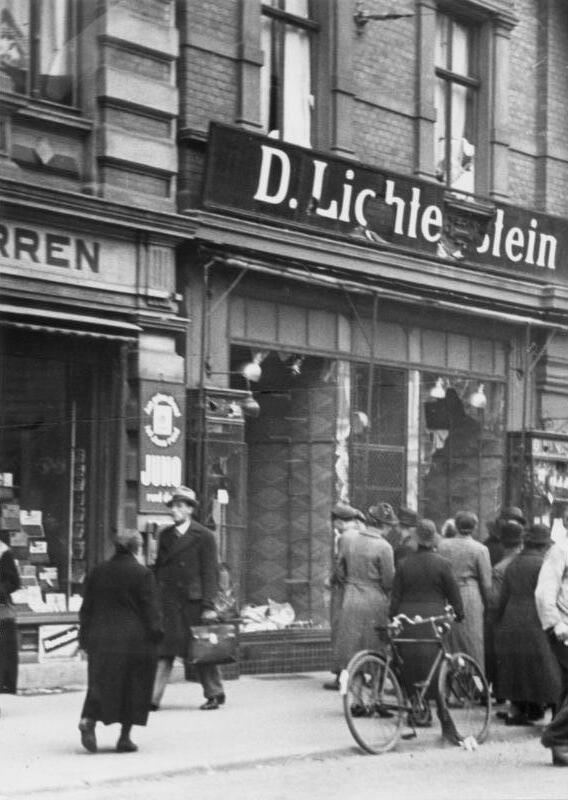
7.2 9–10 November 1938: the pogrom and the demolition
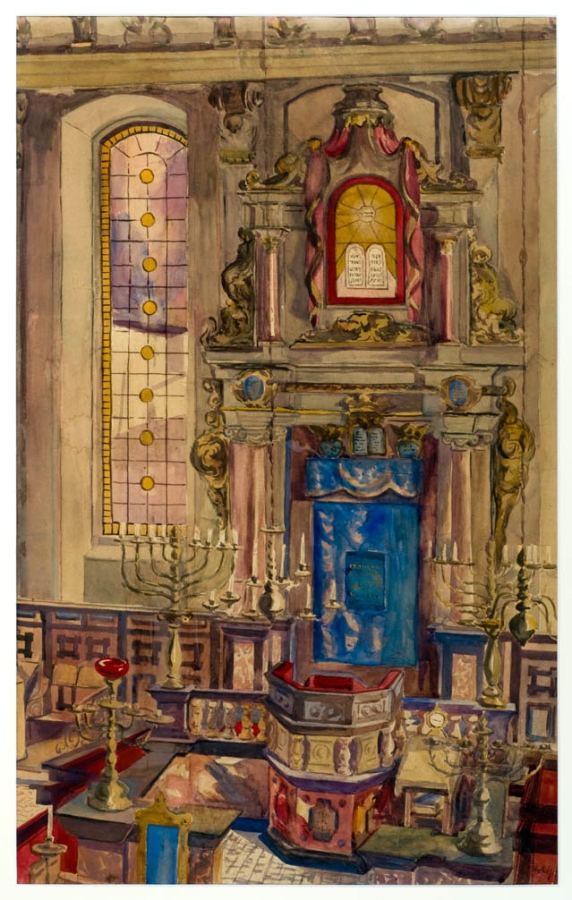
On the night of 9–10 November 1938 — the November pogrom, Kristallnacht — Lehmann’s synagogue, in continuous use since 1712, was plundered and set on fire. Torah scrolls were dragged out and burned in the streets; the reference literature gives ninety desecrated, while the memorial that now occupies the site represents seventy-two, and the Lipke watercolour of 1930 (Figure 8) records “more than seventy” kept in the ark.38 Around forty Jewish men of Halberstadt were arrested and sent to Buchenwald concentration camp.
One detail explains the building’s particular fate. German accounts record that the SA, having set the fire, then extinguished it — to protect the adjoining half-timbered houses. The synagogue therefore could not be allowed to burn down; it had to be taken apart. On 18 November the municipal building inspection ordered the demolition of the structure, on the ground that the fire and the mob had conveniently rendered it unsafe, and demolition began within days. In a final refinement of cruelty, the Jewish community itself was compelled to bear the costs of tearing down its own sanctuary.39 Of the building that had crowned Jewish Halberstadt for two and a quarter centuries, only the outer wall of the entrance hall, the foundations, and the flooring remained.
EXCURSUS: THE WIDER WORLD. Across Germany and annexed Austria that night, more than 1,400 synagogues were torched, thousands of Jewish businesses and homes were wrecked, at least 91 Jews were murdered, and some 30,000 Jewish men were sent to concentration camps — most released over the following months only on condition of emigration. The state then fined the Jewish community a billion Reichsmarks for the damage done to it. Kristallnacht marked the passage from persecution to open violence — the last great pogrom of the old kind, and the threshold of something without precedent.40
7.3 1942: “nobody returned”
The deportations came in 1942. On 12 April, 102 Jews from Halberstadt were assembled; on 13 April they were moved to the Magdeburg assembly camp; and on 14 April they were deported via Berlin in a combined transport of roughly 446 people, together with 344 others from the Magdeburg district. Their destination is generally reconstructed as the Warsaw ghetto. No survivor of that transport is known.41 A further transport carried the community’s remaining, mostly elderly members to Theresienstadt on 23 November 1942.
The total must be stated carefully, because a figure of roughly four hundred deported and murdered circulates widely and is not supported by the reference literature. The Encyclopaedia Judaica records that 186 persons were deported between 1939 and 1942 and that none returned; the memorial volume compiled by Werner Hartmann for the fiftieth anniversary of the pogrom, which preserves the deportation lists name by name, records approximately two hundred names.42 A figure of roughly 190 to 200 deported from Halberstadt itself is the defensible one. A larger number — of Jews born in Halberstadt and murdered elsewhere, after emigration within Germany — is a legitimate and different count, and any source giving a higher figure should be asked which population it means.
The outcome is not in doubt. The memorial volume states it in four German words that need no commentary: niemand kehrte zurück — nobody returned.
7.4 The perpetrators next door: the Bormann brothers
Halberstadt was not only a place where the catastrophe happened; it was a place the catastrophe came from.
Martin Bormann was born on 17 June 1900 in Wegeleben, a village some thirteen kilometres from Halberstadt — a proximity that has led several reference works simply to give Halberstadt as his birthplace, which is an error worth correcting.43 Convicted in 1924, alongside the future Auschwitz commandant Rudolf Höss, as an accomplice in a political murder, he rose to become head of the Nazi Party Chancellery and Hitler’s private secretary — by the war years arguably the second most powerful man in the Reich, controlling access to Hitler and signing off on the machinery of persecution. The Nuremberg tribunal sentenced him to death in absentia. His younger brother Albert Bormann, born in Halberstadt itself on 2 September 1902, served at the same court as Hitler’s personal adjutant and head of the personal-affairs office of the Führer’s Chancellery.
The town that gave German Jewry Jacobson and Hildesheimer gave the Reich the Bormanns — a symmetry as instructive as it is bitter.
7.5 The machinery in Halberstadt’s own hills: Langenstein-Zwieberge
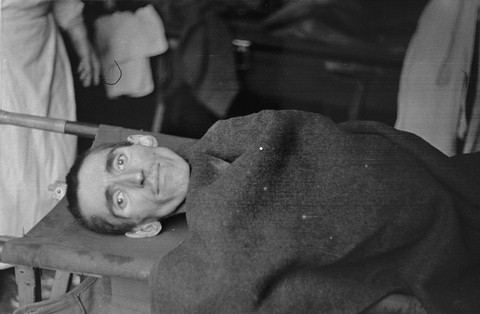
In April 1944 the SS established Langenstein-Zwieberge, a subcamp of Buchenwald, in the Thekenberge just outside town — the village of Langenstein has since been absorbed into Halberstadt itself. More than 7,000 prisoners from twenty-three countries, Jews and non-Jews, were driven to carve roughly thirteen kilometres of tunnels into the rock for an underground Junkers aircraft plant, code-named “Malachit,” safe from Allied bombing.44
Conditions were among the worst in the entire Buchenwald system: nearly a third of all prisoners died. In the camp’s worst single week, in late March 1945, it recorded 234 deaths — more than any other Buchenwald subcamp. Deaths ran at roughly three hundred a month, and at twenty-five to thirty a day even after liberation. Beginning on 9 April 1945, days before American troops arrived, some 3,000 prisoners were driven out on a death march, in six columns, that killed most of them.
A memorial has stood at the mass graves since its dedication on 11 September 1949; today the Langenstein-Zwieberge Memorial preserves the camp grounds, opens 120 metres of the tunnels, and, since 2011, has marked the buried dead with individual name plaques.
8. Memory, Justice, and Return, 1945–2026
8.1 Fragments, and forty-five years of official forgetting
After the war, and through the decades of East German rule, the physical traces of Jewish Halberstadt survived in fragments: the Klaus, the cantor’s house, the mikveh house with its seventeenth-century half-timbering, three Jewish cemeteries, and the ruined wall of the synagogue’s entrance hall. The community’s ritual bath, though dismantled in the 1950s, was preserved in substance. A richly decorated Baroque doorway near the synagogue site, locally associated with Berend Lehmann’s residence, was taken down in 1986.
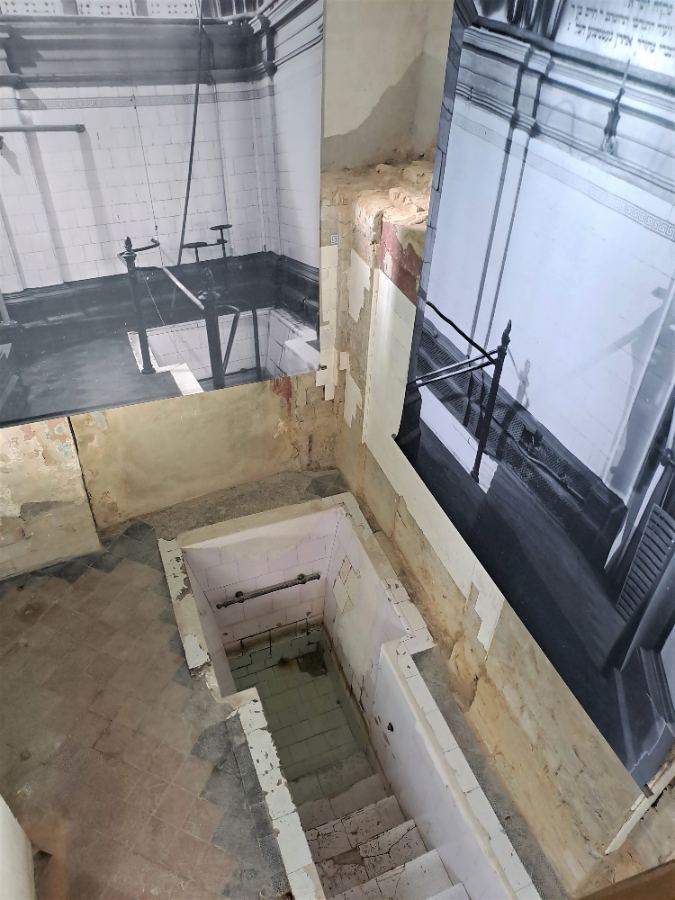
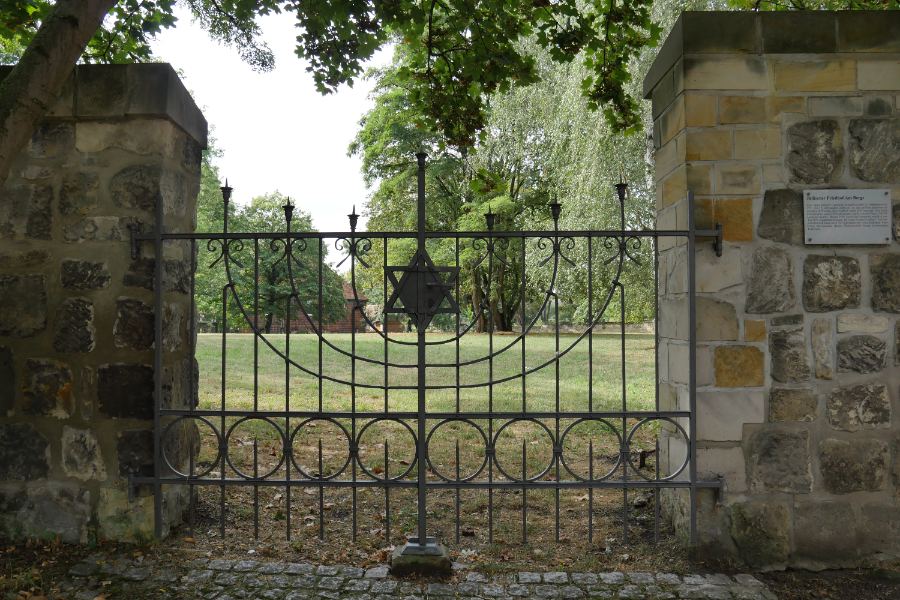
The East German decades deserve their own sentence rather than a silent gap, and they now have their own monograph: Philipp Graf’s Ausgeschlagenes Erbe (“A Legacy Declined”) examines how the GDR handled — and largely declined to handle — the Jewish history of Halberstadt.45 The German Democratic Republic, which held the town until 1990, also refused restitution altogether, declaring the “antifascist” state free of the Reich’s debts. That refusal is the reason the Reichenbach family’s East German property questions could not even be raised until after 1990.
8.2 After 1990: memory becomes institution
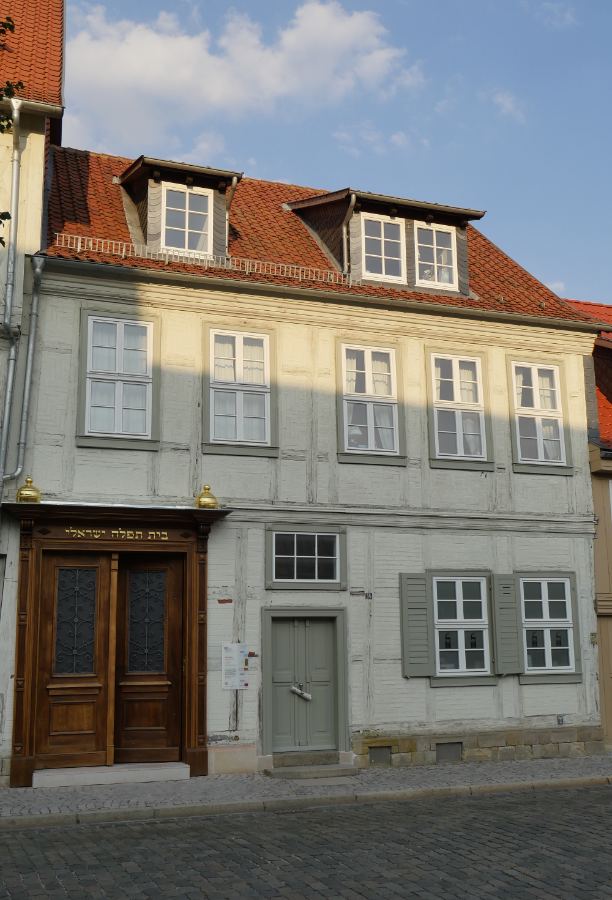
After German reunification, memory became institution. The Moses Mendelssohn Academy, established in Halberstadt in 1995, set out to save the former Jewish community centre — the Klaus with its teaching house and synagogue in the Rosenwinkel, and the cantor’s house on Bakenstrasse, the mikveh house. In 2001 the Academy opened the Berend Lehmann Museum in two half-timbered houses beside the site of the destroyed synagogue; the preserved mikveh forms the core of the museum, whose permanent exhibition — on kosher life, the Klaus, and the community’s crafts and commerce — documents both the court Jew’s life and the centuries of Jewish Halberstadt after him.46
Since 2008 the footprint of the vanished Baroque synagogue has been marked by a room-sculpture by the artist and botanist Olaf Wegewitz, titled Denk-Ort — Und die Lebenden nehmen sich das zu Herzen (“Place of Remembrance — And the living take this to heart,” from Ecclesiastes). Dedicated on 20 November 2008, seventy years to the day after the demolition began, it lays paths across the site, sets tiles patterned after the Baroque synagogue’s decoration and inscribed with Hebrew plant names, and marks seventy-two circular depressions for the community’s Torah scrolls.47
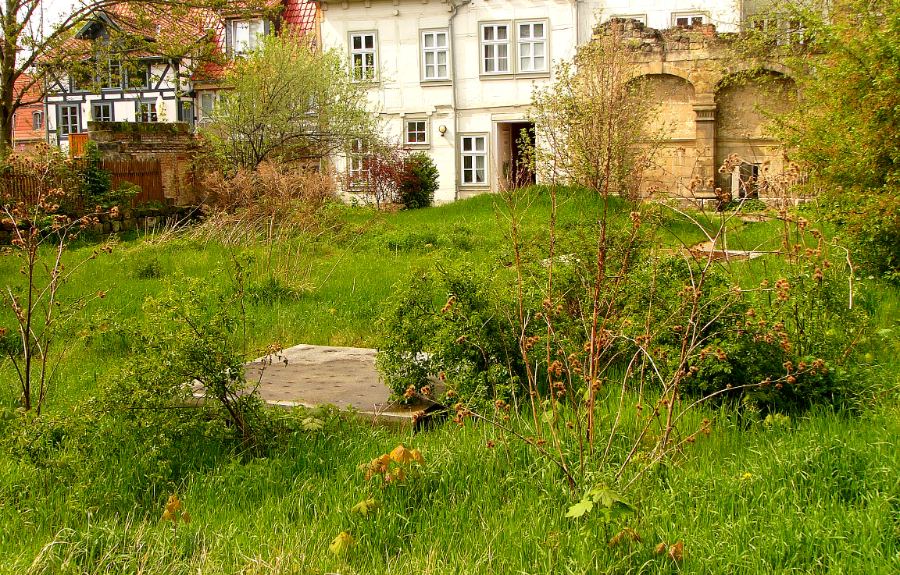
The town’s official heritage materials today present the Jewish quarter — Judenstrasse, Bakenstrasse, Rosenwinkel — as central to Halberstadt’s identity. For the Reichenbach Family Archive this landscape of memory is not abstract: it is the streetscape of the family’s own history, the town of Jacob Reichenbach’s stores and of Paul Reichenbach’s grave.
8.3 The reckoning: justice, teshuvah, and stone
The retreat of antisemitism from public legitimacy, such as it was, happened in stages that deserve their own dates. At Nuremberg in 1945–46 the International Military Tribunal made the persecution and murder of the Jews a matter of judicial record and hanged some of its architects. The Jerusalem trial of Adolf Eichmann in 1961 put survivor testimony at the centre of world attention and made the Shoah, for the first time, a story the whole world heard from the mouths of those who lived it. And in October 1965 the Second Vatican Council’s declaration Nostra Aetate formally repudiated the charge of collective Jewish guilt for the crucifixion — renouncing, after nineteen centuries, the theological root from which the blood libels, the host-desecration tales, and the expulsion sermons of §§2–3 had grown.48
Memory then came down to street level: since the 1990s the artist Gunter Demnig’s Stolpersteine — brass “stumbling stones” set into pavements before the last freely chosen homes of the murdered — have spread across Europe, past the hundred-thousandth stone, making the largest decentralised memorial on earth. Halberstadt has its own; one, at Finckestrasse 7, commemorates Mary Rosner, born Grünberg in 1890, deported to the Warsaw ghetto on 12 April 1942 — the transport of §7.3.
8.4 Wiedergutmachung: restitution, and a family receipt
Alongside the state-level settlement ran the vast, grinding machinery of individual restitution — Wiedergutmachung, “making good again,” a word whose inadequacy Germans and Jews alike understood from the start. Israelis pointedly called the payments shilumim, payments rather than atonement, and the decision to take German money at all nearly tore Israel apart: in January 1952, as the Knesset debated, Menachem Begin led furious crowds against the very idea of “blood money,” and stones came through the parliament’s windows. On the German side the honesty cut the other way: when the Bundestag ratified the Luxembourg Agreement in March 1953, it passed on the unanimous votes of the opposition Social Democrats, while a large part of Adenauer’s own coalition abstained or voted against. The generation that paid was never a unanimous generation — which makes those who pushed it through the more worth naming.
The legal architecture grew in layers: Allied-zone property restitution laws from 1947; the Federal Compensation Law (Bundesentschädigungsgesetz, BEG) of 1953, expanded in 1956 and finalised in 1965, under which millions of claims were processed for loss of life, health, liberty, property, and careers — pensions and lump sums paid to survivors and heirs across the world; the Federal Restitution Law of 1957 for property seized by the Reich; the Claims Conference’s successive funds for those the early laws missed; and, in 2000, the foundation “Remembrance, Responsibility and Future,” financed half by German industry, which paid more than 1.6 million surviving forced labourers. Across all programmes, Germany’s payments have run well beyond eighty billion euros — the largest reparations effort in history, and still, measured against what was taken, a gesture.49
One wrinkle bears directly on Halberstadt. East Germany, which held the town until 1990, refused restitution altogether. Property claims in Halberstadt and Wernigerode became possible only after reunification, under the Property Law of 1990, with the Claims Conference standing as legal successor for property whose heirs could not be found.
The Reichenbach family received restitution payments — the Archive preserves this as family knowledge, and it is entirely consistent with the record: a Halberstadt merchant family’s losses of business, property, livelihoods, and lives fall squarely within what the BEG and the restitution laws compensated. The paper trail is one of the richest research veins the Archive has, and Appendix C names the specific offices and record series.
And restitution continues, in Halberstadt itself, at human scale. On 14 February 2024 the Moses Mendelssohn Academy returned nine books to Paul Chodziesner of Melbourne, the great-grandson of the Berlin lawyer Ludwig Chodziesner — volumes confiscated from Jews before deportation, recovered after the war, and traced to their owner by the provenance research of Irena Strelow. Ludwig Chodziesner, disbarred in 1936 after forty-five years of practice, was deported to Theresienstadt in September 1942 and died there in February 1943; he was the father of the poet Gertrud Kolmar, deported to Auschwitz months after him. “The more the history is illuminated,” his great-grandson said, “the more you understand what my ancestors went through.”50
The family’s own words are the right ones, and this paper adopts them: a generation of Germans — never all of them, but enough of them — tried to make things not right, which was impossible, but better. Willy Brandt falling to his knees in Warsaw in 1970 said with his body what no payment schedule could: that the debt was unpayable and had to be acknowledged anyway.
8.5 The return — and an honest ending
Jewish life itself came back. After 1990 reunified Germany admitted, in the course of Jewish immigration from the collapsing Soviet Union, roughly 220,000 people, of whom about 199,000 entered under the quota-refugee framework in force until the end of 2004.51 More than half joined Jewish communities, whose membership rose by up to ninety per cent. It is the great irony of the century’s end: the grandchildren of the Jews the Reich tried to annihilate rebuilding communities on German soil, including in Saxony-Anhalt, where congregations in Magdeburg, Halle, and Dessau were reborn largely Russian-speaking. In Halberstadt, the Moses Mendelssohn Academy keeps the buildings, the scholarship, and the visitors coming; in 2026 the Berend Lehmann Museum marks its twenty-fifth anniversary, and on 9 July 2026 a three-party agreement between the state of Saxony-Anhalt, the city of Halberstadt, and the Academy’s foundation placed the museum on permanent funding — the state contributing sixty per cent, some €808,000 over five years.52
Honesty requires the last word to be careful. Antisemitism did not fall in 1945; it transformed. The Soviet bloc recycled it as “anti-Zionism” and show trials; Holocaust denial gave it a new literature; and in the twenty-first century it has returned openly. On Yom Kippur, 9 October 2019, a gunman tried to storm the packed synagogue in Halle — under eighty kilometres from Halberstadt as the crow flies — and, when the door held, murdered two passers-by, Jana Lange and Kevin Schwarze, neither of them Jewish.
Nor is the resurgence a matter of lone gunmen. In Halberstadt’s own state of Saxony-Anhalt, the Alternative für Deutschland’s state branch has been classified since 8 November 2023 by the state’s Office for the Protection of the Constitution as a “proven right-wing extremist” endeavour.53 As of early August 2026, one month before the Saxony-Anhalt state election of 6 September 2026, that party polls at around 41 per cent — roughly double its 2021 result — against 24 per cent for the CDU of Minister-President Sven Schulze, who took office on 28 January 2026, with the Linke at 13 per cent.54 Every other party rules out coalition with the AfD, but no non-AfD majority is available without an unprecedented four-party arrangement. Observers from Jewish organisations and civil-society foundations warn explicitly about what such a government would mean for the culture of memory — for institutions like the memorials and museums this paper has leaned on throughout.
Eighty-one years after Langenstein-Zwieberge, a party officially designated extremist by the constitutional watchdog stands within reach of leading the state that contains it. The arc of this history is therefore not rise-and-fall but rise, catastrophe, reckoning, and vigilance — which is precisely why a family archive that shows eight centuries of this history through one family’s faces is not nostalgia. It is equipment.
9. Conclusion
Three findings emerge from placing Halberstadt’s local record against the European one.
First, divided sovereignty cut both ways. The standard expectation — confirmed statistically by Finley and Koyama for the Holy Roman Empire — is that ecclesiastical territories and imperial free cities were the most dangerous places for Jews, because contested jurisdiction multiplied the parties with an interest in extracting or expropriating. Halberstadt was such a place, and it produced two expulsions, a riot that destroyed a synagogue with military assistance, and centuries of fiscal predation. Yet the same divided authority also produced the town’s most remarkable episode: in 1669 a Jewish community sued a Christian city for a pogrom and won. It could do so precisely because there was a higher authority — the Elector — whose interests ran against the city’s. Protection was never a right; it was a by-product of rivalry. Where the rivalry vanished, as it did under the unitary modern state after 1933, so did the protection.
Second, the town’s religious productivity was not incidental to its precariousness but continuous with it. Berend Lehmann endowed a house of study rather than a monument, in a generation that had just watched messianic hope collapse; the community that could not obtain permission to rebuild its synagogue for forty years held services in its houses and funded a Talmud school while servicing debts contracted to pay its own taxes. That a town of this size produced both Israel Jacobson and Esriel Hildesheimer — the founder of Reform and the architect of modern Orthodoxy, born a few streets and fifty-two years apart — is not a curiosity of biography. Both men were answering the same question, posed with unusual sharpness in a place that had been intensely learned and intensely vulnerable for six centuries: on what terms can a Jew be a European?
Third, the twentieth century broke the pattern rather than continuing it. Every earlier catastrophe in this history was, in principle, survivable and, in practice, survived: expulsion could be followed by return, because the expelling authority eventually wanted the Jews back. Racial antisemitism removed both the exit of conversion and the logic of readmission. When the Halberstadt synagogue was demolished in November 1938, the community was made to pay for the demolition — a detail that captures the difference exactly. The medieval mechanism extracted from Jews because they were useful. The modern one extracted from them on the way to killing them.
What survives is fragmentary and deliberate: a mikveh, a house of study, three cemeteries, a wall, a watercolour of a room that no longer exists, a wool trader’s ledger sealed in a wall for two and a half centuries, and seventy-two circular depressions in a stone floor. The Reichenbach Family Archive belongs to that category of survival. Its value is not that it preserves a family — though it does — but that it supplies the one thing this kind of history most conspicuously lacks: faces attached to the mechanism.
Appendix A. Chronology
| Date | Event |
|---|---|
| 1096 | Rhineland massacres during the First Crusade open the era of organised anti-Jewish violence in the German lands. Rashi (d. 1105) and the Tosafists nonetheless make Ashkenaz a centre of Jewish learning. |
| 1144 | First ritual-murder accusation in Europe, at Norwich, England. |
| 1190 | The Jews of York, besieged in Clifford’s Tower, die largely by their own hands rather than accept baptism; the mob burns its debt records in York Minster. |
| 1215 | Fourth Lateran Council mandates distinguishing dress for Jews. |
| 1235 | Blood libel at Fulda kills 34 Jews; Frederick II’s inquiry pronounces the accusation baseless — to little lasting effect (Trent 1475; Damascus 1840). |
| 1230s–1242 | Maimonidean controversy divides the Jewish world; the Talmud is tried in Paris (1240) and burned by the cartload (1242). |
| 1261 | Bishop Volrad von Kranichfeld and the city council issue a grant of protection “as of old” — the earliest documentary evidence of Jews in Halberstadt. |
| 1290 / 1306 | England, then France, expel their Jews; Jewish migration shifts toward the German lands and Poland. |
| 1343 | Attack on the Halberstadt Jews by the counts of Mansfeld and Regenstein. |
| 1348–51 | Black Death pogroms annihilate communities across Europe (Strasbourg, 14 Feb. 1349; Basel; Erfurt). Halberstadt’s records show lending activity continuing, with no recorded violence — a documented exception. |
| 1364 | A Judendorf with a synagogue first mentioned in Halberstadt. |
| 1453 | Constantinople falls; the Ottoman Empire will soon absorb Sephardic refugees. |
| 1456 | Eleven Jewish families recorded, mainly moneylenders. |
| 1492 / 1497 | Alhambra Decree expels the Jews of Spain; Portugal follows. |
| 1493 | Ernst of Saxony, Archbishop of Magdeburg and administrator of Halberstadt, expels the Jews from his territories. |
| 1543 | Luther publishes his anti-Jewish tracts. |
| 1565 / c. 1570 | Karo’s Shulchan Aruch printed; Isserles’ glosses adapt it for Ashkenaz. In Safed, Isaac Luria (d. 1572) recasts Kabbalah. |
| 1594/95 | Second expulsion from Halberstadt, by Heinrich Julius of Brunswick-Wolfenbüttel; readmission c. 1606; families return and build a synagogue. |
| 1621 | The synagogue is destroyed in a mob attack on money-changers during the Kipper- und Wipperzeit. |
| 1618–48 | Thirty Years War. The Peace of Westphalia (1648) secularises the bishopric; Halberstadt passes to Brandenburg-Prussia. |
| 1648–49 | Khmelnytsky uprising destroys hundreds of Jewish communities in Ukraine and Poland. |
| 1650 | Ten Jewish families granted privileges of residence and trade — with synagogue construction expressly forbidden. |
| 1656 | Jews readmitted to England under Cromwell. |
| 1661 | The Halberstadt community granted the right to elect a rabbi. Berend Lehmann born in Essen. |
| 1665–66 | Shabbetai Zvi proclaimed messiah; his conversion to Islam turns communal energy toward law and study. |
| 18 March 1669 | A mob, aided by the military, demolishes the Judenstrasse synagogue; the hammer is preserved in the parish house. The community sues, the city is made to pay compensation — but rebuilding is refused. |
| 1679 | Burial society (chevra kadisha) founded. |
| 1689 / 1707 | Lehmann establishes a bet midrash that becomes the renowned Klaus. |
| 1691 | Glikl of Hameln begins her Yiddish memoirs. |
| 1697 | Lehmann finances Augustus the Strong’s election to the Polish throne; named Resident of the King of Poland, seated in Halberstadt. |
| 1697–99 | Lehmann sponsors the twelve-volume “Bermann Talmud” at Frankfurt an der Oder — the first complete German printing of the Babylonian Talmud; much of the run given away. |
| 1699 | Community numbers 118 families (639 persons). |
| 1712 | Baroque synagogue inaugurated, hidden behind Bakenstrasse and Judenstrasse; its cupola twice the height of the surrounding houses. |
| 1718–48 | Rabbi Zevi Hirsch Bialeh (“Harif”) leads the community; the Talmud school flourishes. |
| 1730 | Berend Lehmann dies in Halberstadt. |
| 1749 | Date on a pawn slip in Isaak Melcher’s ledger — the wool trader’s business book later found in a Halberstadt house wall (2015) and now in the Berend Lehmann Museum. |
| 1750 | Frederick the Great’s General Ordinance restrictively regularises Jewish status in Prussia. |
| c. 1740–97 | Rise of Hasidism under the Baal Shem Tov (d. 1760); the Vilna Gaon (d. 1797) leads the opposition. |
| 1757–59 | Jacob Frank’s Sabbatian sect instigates the Kamieniec and Lwów disputations, then converts en masse to Catholicism. |
| 1768 | Israel Jacobson, the father of Reform Judaism, born in Halberstadt. |
| 1775–1824 | Rabbis Löb Eger and then Akiba Eger III; taxes reach c. 2,500 thalers (1794); Hascharath Zwi school for poor children founded (1795/96). |
| 1807–13 | Halberstadt in Napoleon’s Kingdom of Westphalia; the 1808 emancipation decree makes its Jews citizens. Jacobson heads the kingdom’s Jewish consistory; on 17 July 1810 he dedicates the Seesen temple. |
| 1812 / 1815 | Prussian Emancipation Edict; after Napoleon’s fall, restoration rolls rights back. |
| 1818 | Hamburg Temple opens; the Reform movement begins reshaping German Judaism. |
| 1820 | Esriel Hildesheimer, founder of modern Orthodoxy’s Berlin Rabbinical Seminary (1873), born in Halberstadt. |
| 1827 | Nicholas I’s cantonist decree conscripts Jewish boys into the Russian army. |
| 1824–1901+ | Rabbis Lewian, B. H. Auerbach (community history 1866; Sefer ha-Eshkol 1867–69), Selig Auerbach, and successors to 1938; Hebrew printing; Hirsch family industry, philanthropy, and the synagogue’s modernisation. |
| 1840 | Damascus blood libel galvanises modern Jewish solidarity. |
| 1848 | Communist Manifesto published; later fuels the “Judeo-Bolshevism” myth. |
| mid-1800s | Jacob Reichenbach (1844–1872) founds the family clothing business, which grows into stores in Halberstadt and Wernigerode. |
| 1869 / 1871 | Full legal emancipation in the North German Confederation, then the German Empire. |
| 1873–79 | Stock-market crash and backlash: Marr coins “antisemitism” (1879), Treitschke lends it academic respectability; hatred turns racial — conversion is no longer an exit. |
| 1873 | Hildesheimer opens the Orthodox Rabbinical Seminary in Berlin. |
| 1876 | Prussian Secession Law; in Halberstadt the battle runs in reverse, the official community being Orthodox. |
| 1881 / 1897 | Russian pogroms begin the mass emigration of Eastern European Jewry; Herzl convenes the First Zionist Congress. |
| 1894–1906 | The Dreyfus Affair; Zola’s J’accuse (1898); Herzl’s turn to Zionism. |
| 1900 / 1902 | Martin Bormann born in Wegeleben near Halberstadt; Albert Bormann born in Halberstadt itself. |
| 1914–18 | c. 100,000 German Jews serve, c. 12,000 fall; the 1916 Judenzählung insults them mid-war; the stab-in-the-back myth follows defeat. |
| 1922 / 1923 | Rathenau assassinated; hyperinflation feeds the agitators. |
| late 1800s–1930s | Eastern European Jews find employment in Orthodox Halberstadt — family tradition recalls them especially in the dairy trade (see §6.4, evidentiary status). |
| until 1930 | Halberstadt serves as the organisational centre of German Orthodox Jewry. |
| 1933 | Nazi seizure of power; boycotts, Nuremberg Laws (1935), forced “Aryanisation.” The Halberstadt community falls from 706 (1933) to 245 (1939). |
| Oct. 1938 | Polenaktion: c. 17,000 Polish Jews expelled from Germany — the Ostjuden first; the Grynszpan family among them. |
| 9–10 Nov. 1938 | Pogrom: the synagogue plundered and burned, Torah scrolls destroyed in the streets; c. 40 men sent to Buchenwald; demolition ordered 18 Nov. at the community’s own expense. |
| 1940 | Goebbels’ film libels: Jud Süß and Der ewige Jude. |
| 1942 | Deportations: 102 persons assembled 12 April, deported 14 April via Berlin, destination reconstructed as the Warsaw ghetto; a final transport to Theresienstadt 23 November. c. 186–200 deported from Halberstadt. Niemand kehrte zurück. |
| 1944–45 | Langenstein-Zwieberge, a Buchenwald subcamp in Halberstadt’s hills: 7,000+ prisoners from 23 countries dig c. 13 km of tunnels; nearly a third die; death march from 9 April 1945. |
| 1945–46 | Nuremberg: the persecution and murder of the Jews entered into judicial record. |
| 1952–53 | Luxembourg Agreement; German reparations begin over furious opposition in Israel and thin support in Adenauer’s coalition. |
| 1953–65 | Federal Compensation Law (BEG); Federal Restitution Law 1957. Total German payments eventually exceed €80 billion. |
| 1961 | Eichmann trial puts survivor testimony before the world. |
| 1965 | Nostra Aetate repudiates the collective-guilt charge. |
| 1970 | Willy Brandt kneels at the Warsaw Ghetto memorial. |
| 1986 | Baroque doorway associated with Lehmann’s residence taken down. |
| 1990 / 2000 | Reunification’s Property Law opens restitution in the former East — the GDR had refused it; the “Remembrance, Responsibility and Future” foundation pays 1.6 million+ former forced labourers. |
| 1990s– | c. 220,000 Jews from the former Soviet Union rebuild Jewish life in Germany; Demnig’s Stolpersteine pass the 100,000th stone. |
| 1995 / 2001 | Moses Mendelssohn Academy established; Berend Lehmann Museum opened, with the preserved mikveh at its core. |
| 2008 | Olaf Wegewitz’s Denk-Ort marks the footprint of the destroyed synagogue, dedicated 20 November — seventy years to the day after demolition began. |
| 2015 | Isaak Melcher’s ledger discovered in a house wall at Bakenstrasse 55. |
| 2019 | Yom Kippur attack on the Halle synagogue, under 80 km from Halberstadt; the door holds; two passers-by murdered. |
| 2023–26 | Saxony-Anhalt’s AfD branch classified “proven right-wing extremist” (Nov. 2023); by August 2026 it polls c. 41 per cent ahead of the state election of 6 September 2026. |
| 2024 / 2026 | The Academy returns Ludwig Chodziesner’s looted books to his great-grandson (14 Feb. 2024); the Berend Lehmann Museum secures permanent funding (9 July 2026) and marks its twenty-fifth year. |
Appendix B. Recommended Reading
An annotated, tiered guide. Full details are in the Bibliography.
B.1 Start here — Halberstadt itself
- Berndt Strobach, Der Hofjude Berend Lehmann (1661–1730) (2018). The standard modern biography, and the single most important book for §4. It replaces a century of anecdotal literature with archival work and is unsparing about the limits of what can be known.
- Philipp Graf, Ausgeschlagenes Erbe: Die jüdische Geschichte Halberstadts in der DDR (2025). Open Access. The only monograph on what happened to Jewish Halberstadt under East German rule — the forty-five-year gap most accounts skip. Essential for §8.
- Beate Reupke, Jüdisches Schulwesen zwischen Tradition und Moderne: Die Hascharath Zwi Schule in Halberstadt (1796–1942) (2017). A community’s whole social history seen through one school. The best single window onto ordinary Halberstadt Jewish life.
- Sabine Klamroth, “Erst wenn der Mond bei Seckbachs steht”: Juden im alten Halberstadt (2014). Accessible, warm, locally grounded; a good first book for a family researcher.
- Jutta Dick, Berend Lehmann: Hofjude Augusts des Starken (2020). Seventy pages, by the director of the Moses Mendelssohn Academy. Read it before Strobach if time is short.
- Werner Hartmann, ed., Juden in Halberstadt, 6 vols. (1988–96). The memorial documentation, including the deportation lists. Not a narrative history; the indispensable source for names.
- Benjamin Hirsch Auerbach, Geschichte der israelitischen Gemeinde Halberstadt (1866). Digitised and free. Read it as a primary source — a serving rabbi writing about his own congregation — and treasure its appendix of otherwise unpublished letters and documents.
B.2 The German-Jewish frame
- Michael A. Meyer, ed., German-Jewish History in Modern Times, 4 vols. (1996–98). The standard survey. Vol. 2 for emancipation, vol. 4 for destruction.
- David Sorkin, The Transformation of German Jewry, 1780–1840 (1987). How a subculture was made. The best account of what Jacobson’s generation was actually doing.
- Mordechai Breuer, Modernity Within Tradition (1992). Neo-Orthodoxy from the inside. Halberstadt is its model community; this book explains why.
- David Ellenson, Rabbi Esriel Hildesheimer and the Creation of a Modern Jewish Orthodoxy (1990). The Halberstadt-born architect of the Berlin seminary.
- Michael A. Meyer, Response to Modernity (1988), with Jacob Rader Marcus, Israel Jacobson (1972). The other pole, also Halberstadt-born.
- Steven E. Aschheim, Brothers and Strangers (1982). The classic study of the German-Jewish encounter with the Ostjuden — the direct scholarly context for the family memory in §6.4.
B.3 The medieval and early modern mechanism
- Julie L. Mell, The Myth of the Medieval Jewish Moneylender, 2 vols. (2017–18). The revision that should govern how anyone now writes about Jews and credit. Demanding but decisive.
- Selma Stern, The Court Jew (1950). Still the foundational study; free online.
- Jonathan I. Israel, European Jewry in the Age of Mercantilism, 1550–1750 (3rd ed., 1998). Why the Great Elector wanted Jews.
- Rotraud Ries and J. Friedrich Battenberg, eds., Hofjuden — Ökonomie und Interkulturalität (2002). The modern collective reassessment of the court-Jew phenomenon.
- Miri Rubin, Gentile Tales (1999) and Robert Chazan, European Jewry and the First Crusade (1987). For §2.
- Voigtländer and Voth (2012) and Finley and Koyama (2018). The quantitative literature, both open in working-paper form. Read them for the pattern Halberstadt breaks.
- Glikl of Hameln, Memoirs. Read them. No secondary work conveys this world as she does.
B.4 Destruction and its aftermath
- Alan E. Steinweis, Kristallnacht 1938 (2009). Concise and authoritative.
- Alina Bothe and Gertrud Pickhan, eds., Ausgewiesen! (2018). On the Polenaktion.
- Wolfgang Benz and Barbara Distel, eds., Der Ort des Terrors, vol. 3 (2006). The authoritative reference on Buchenwald and its subcamps, including Langenstein-Zwieberge. Note that there is no standard scholarly monograph on that camp; the literature is largely survivor memoir — see Georges Petit, Retour à Langenstein (2001).
- Constantin Goschler, Schuld und Schulden (2005), and, in English, Dean, Goschler, and Ther, eds., Robbery and Restitution (2007). The restitution history that frames §8.4 and the family’s own compensation file.
Appendix C. A Research Guide for the Reichenbach Family Archive
This appendix converts the paper’s open questions into a work plan. Three memories and one documented fact in the family’s record can be tested against paper.
C.1 The two family traditions
Question 1: Were Eastern European Jews employed in the Halberstadt dairy trade, and how were they regarded? (§6.4)
Records to seek: community employment records and kashrut-supervision records (chalav yisrael certification generates paperwork); trade-register and business-licence files for dairies; residence-registration files (Einwohnermeldekartei) for foreign nationals; the community’s own protocols. Held by the Moses Mendelssohn Academy, the Landesarchiv Sachsen-Anhalt, and the Historisches Archiv der Stadt Halberstadt.
Question 2: Were the Reichenbachs non-religious liberals in an Orthodox town? (§6.5)
Records to seek: synagogue seat records (Sitzplatzverzeichnisse) — the single most direct evidence of attendance and standing; community tax rolls (Kultussteuerlisten), which record membership and assessment even for the non-attending; school enrolments, especially whether Reichenbach children attended the Hascharath Zwi school, the municipal Gymnasium, or both; and burial records, which reveal whether the family used the community cemetery. Gemeinde records via the Moses Mendelssohn Academy and the Landesarchiv Sachsen-Anhalt.
C.2 Military service, 1914–18 (§6.6)
Records of the Reichsbund jüdischer Frontsoldaten; regimental rolls and Verlustlisten; the surviving fragments of the 1916 Judenzählung returns; and the memorial lists of Jewish war dead published by German communities in the 1920s.
C.3 Persecution, expropriation, and deportation, 1933–45 (§7)
Start with the Hartmann memorial volumes, which reproduce the deportation lists name by name. Then: “Aryanisation” files and trade-register deletions for the family’s stores in Halberstadt and Wernigerode; the property-transfer records of the Reich; the Gestapo and finance-office files on asset seizure (Vermögensverwertung); and the individual case records in the databases below.
- USHMM Holocaust Survivors and Victims Database — https://www.ushmm.org/online/hsv/
- Yad Vashem, Central Database of Shoah Victims’ Names — https://yvng.yadvashem.org/
- Arolsen Archives (International Center on Nazi Persecution), online collections — https://collections.arolsen-archives.org/
- #LastSeen Bildatlas, Halberstadt — https://atlas.lastseen.org/image/halberstadt/207
C.4 Restitution and compensation, 1947– (§8.4)
This is, as §8.4 notes, the richest documentary vein available to the Archive, because compensation files typically contain sworn family testimony, inventories of what was lost, and documents obtainable nowhere else.
- BEG compensation files — originally held by the state restitution offices (Entschädigungsbehörden) and increasingly transferred to state archives.
- Property restitution case files under the Allied-zone laws and the Federal Restitution Law of 1957.
- Post-1990 files of Saxony-Anhalt’s offices for unresolved property questions (Amt zur Regelung offener Vermögensfragen) — the necessary route for the family’s East German real estate, since the GDR refused restitution and no claim could be filed before 1990.
- Claims Conference — https://www.claimscon.org/
C.5 Institutions to contact
| Institution | Holdings relevant to the Archive |
|---|---|
| Stiftung Moses Mendelssohn Akademie Halberstadt, Rosenwinkel 18 — https://berendlehmannmuseum.de/en/moses-mendelssohn-academy/ | Community records, local research, provenance work; the natural first partner, and demonstrably generous to serious researchers. |
| Berend Lehmann Museum, Halberstadt — https://berendlehmannmuseum.de/ | Objects, images, the Melcher ledger; image permissions. |
| Landesarchiv Sachsen-Anhalt — https://landesarchiv.sachsen-anhalt.de/ | Regional civil, community, and government records; the Wernigerode site holds the Halberstadt principality and domain records. |
| Historisches Archiv der Stadt Halberstadt (Städtisches Museum) — https://www.museum-halberstadt.de/de/Stadtarchiv.html | Municipal records: building inspection, trade registers, residence registration. |
| Leo Baeck Institute, New York/Berlin, and DigiBaeck — https://www.lbi.org/collections/digibaeck/ | German-Jewish family papers, memoirs, community histories; substantially digitised. |
| Center for Jewish History, New York — https://www.cjh.org/ | Hildesheimer and related Halberstadt family papers. |
| Synagogengemeinde Magdeburg | Legal successor body for the Halberstadt community’s records. |
| JewishGen — https://www.jewishgen.org/ | Indexed German-Jewish vital records. |
| jüdische-gemeinden.de, Halberstadt page | The most current German-language gazetteer entry, with an up-to-date bibliography. Note that Alemannia Judaica, often recommended, covers only the Halberstadt cemeteries; its regional focus is south-west Germany. |
C.6 Two standing cautions
- Names. Three rabbis named Akiba Eger appear in this history (§5.1). Always record dates alongside names when working with the community’s rabbinic succession.
- Numbers. When any source gives a deportation figure for Halberstadt, establish whether it counts persons deported from the town (c. 186–200) or Jews born in the town and murdered anywhere (a larger and legitimately different figure). See §7.3.
Appendix D. Figure Credits, Licences, and Rights Guidance
D.1 Figure credits
Every figure in this paper is in the public domain or under a Creative Commons licence. Each entry below was verified against the file description page on Wikimedia Commons in August 2026. Where a licence requires attribution, the credit is the one printed in the caption.
| Fig. | Subject | Creator / date | Licence | File page |
|---|---|---|---|---|
| 1 | Halberstadt from the west | Detroit Publishing Co., c. 1890–1900 (Library of Congress) | Public domain (published before 1931) | Halberstadt-um1900.jpg |
| 2 | Diocese of Halberstadt before the Reformation | NordNordWest, cropped by Rabanus Flavus, 2020 | CC BY-SA 3.0 DE — attribution and share-alike required | Bistum Halberstadt vor der Reformation.png |
| 3 | Burning of Jews, 1349 | Unknown, 14th c. (KBR Brussels, MS 13076–77) | Public domain | 1349 burning of Jews.jpg |
| 4 | Berend Lehmann’s gravestone | Unknown, published 1925 | Public domain (published before 1931) | Bären und Levitenkanne…jpg |
| 5 | Klaussynagoge | Xocolatl, 2015 | CC BY 3.0 or GFDL (reuser’s choice) — attribution required | Halberstadt Klaussynagoge.jpg |
| 6 | Synagogue exterior, c. 1930 | Unknown | Public domain | Halberstadt Synagoge 1.png |
| 7 | Synagogue interior, c. 1920 | Unknown | Public domain | Halberstadt Synagoge 2.jpg |
| 8 | Synagogue interior, watercolour | Käthe Lipke, 1930 (Berend Lehmann Museum) | CC BY-SA 4.0 — attribution and share-alike required | Inneres der Halberstädter Synagoge.jpg |
| 9 | Israel Jacobson | Artist unknown, before 1828 | Public domain (PD-Art) | Israel Jacobson.jpg |
| 10 | Jacobson School and Jacobstempel, Seesen | Unknown, postcard c. 1900 | Public domain | Ecole Jacobson et synagogue.jpg |
| 11 | Esriel Hildesheimer | Unknown, before 1899 | Public domain | Hildesheimer Azrial enface.jpg |
| 12 | Benjamin Hirsch Auerbach | Schwadron Collection, National Library of Israel, 1865 | Public domain | Benjamin Hirsch Auerbach.jpg |
| 13 | Wittenberg Judensau, broadsheet | Wolfgang Meissner, Wittenberg, 1596 | Public domain (PD-Art) | Wittenberg Judensau Grafik.jpg |
| 14 | Destroyed Jewish shop, Magdeburg | Unknown, November 1938 (Bundesarchiv) | CC BY-SA 3.0 DE — credit exactly as: Bundesarchiv, Bild 146-1979-046-23 / CC-BY-SA 3.0 | Bundesarchiv Bild 146-1979-046-23 |
| 15 | Synagogue entrance, Bakenstrasse 56 | FrankBothe, 2016 | CC BY-SA 4.0 | Halberstadt, Bakenstr 56.jpg |
| 16 | Langenstein survivor evacuated | Dr Bernard Metrick, April 1945 (USHMM #10108) | Public domain (US federal government work) | Buchenwald Langenstein…10108.jpg |
| 17 | Mikveh, Judenstrasse 26 | Catatine, 2022 | CC0 — no conditions | Mikwenhaus, Halberstadt 01.jpg |
| 18 | Jewish cemetery gate, Westendorf | FrankBothe, 2016 | CC BY-SA 4.0 | Halberstadt, Jüdischer Friedhof.jpg |
| 19 | Synagogue site remains | Gliwi, 2017 | CC BY-SA 4.0 | Synagoge Judenstraße (Halberstadt).jpg |


.jpg)


.jpg)
A note on share-alike. Figures 2, 8, 14, 15, 18, and 19 carry share-alike terms. Share-alike attaches to adaptations of the image, not to the text of a page that displays it: reproducing these photographs unmodified, with the stated credit and a link to the licence, does not oblige you to license this paper under CC BY-SA. Cropping, recolouring, or compositing them does create an adaptation, which must then be released under the same licence. Where you would prefer to avoid the question entirely, Figures 1, 3, 4, 6, 7, 9, 10, 11, 12, 13, and 16 are public domain and Figure 17 is CC0.
A note on hosting. The image URLs in this document point at Wikimedia’s servers. For a production website, download each file and host it yourself: hotlinking is discouraged at scale, and a self-hosted copy will not vanish if a file is renamed or deleted upstream. The credit line must travel with the image either way.
D.2 Gaps: what could not be sourced openly
Stated here so that no future editor repeats the search.
- No portrait of Berend Lehmann appears to exist as an openly licensed image, and quite possibly none exists at all. Figure 4, his gravestone, is the closest available substitute.
- No image of the “Bermann Talmud” (Frankfurt an der Oder, 1697–99) was found on Commons. Do not substitute a title page from another edition without saying so.
- No free photograph of Willy Brandt’s Kniefall in Warsaw, 1970, exists; the canonical images remain press photographs under copyright. Only the monuments and plaques are freely licensed.
- No openly licensed photograph of the Langenstein-Zwieberge tunnels was found; Figure 16 is the strongest available camp image.
- No Merian view of Halberstadt was located, though early-modern engraved maps of the bishopric by Blaeu (1659) and by Schenk and Valck (after 1673) are on Commons and are public domain, should a future edition want them.
- No openly licensed image of the Reichenbach stores was found. If any survives, it will be in the family’s own holdings, in the Historisches Archiv der Stadt Halberstadt, or in the illustrated trade press of the period.
D.3 A note on reuse
Every fact in this paper may be freely restated. The nineteenth-century sources quoted here (Auerbach 1866, the Jewish Encyclopedia of 1901–06) are in the public domain; modern scholarship remains in copyright and should be cited, not reproduced. Image rights are itemized figure by figure in D.1; when reusing any image, keep its credit line. Enquiries about family-held material: see Rights & Reuse on the archive site.
Bibliography
Reference works
Avneri, Zvi, rev. Larissa Daemmig. “Halberstadt.” In Encyclopaedia Judaica, 2nd ed., edited by Fred Skolnik and Michael Berenbaum, vol. 8. Detroit: Macmillan Reference USA in association with Keter, 2007.
Alicke, Klaus-Dieter. Lexikon der jüdischen Gemeinden im deutschen Sprachraum. Vol. 2, Großbock–Ochtendung. Gütersloh: Gütersloher Verlagshaus, 2008.
Deutsch, Gotthard, and B. Auerbach. “Halberstadt.” In The Jewish Encyclopedia, 6:164–66. New York: Funk and Wagnalls, 1904. https://www.jewishencyclopedia.com/articles/7084-halberstadt.
Germania Judaica. Vol. 2, Von 1238 bis zur Mitte des 14. Jahrhunderts, edited by Zvi Avneri, 2 half-vols. Tübingen: J. C. B. Mohr, 1968. Vol. 3, 1350–1519, edited by Arye Maimon, Mordechai Breuer, and Yacov Guggenheim, 3 parts. Tübingen: J. C. B. Mohr, 1987–2003.
Note. Sources conflict on where the Halberstadt article falls: the Encyclopaedia Judaica cites Germania Judaica I, 123–24; II, 317–19; and III, 493–97, while some German gazetteers cite “II,1, 493–97.” Verify against the physical volumes before citing pages.
Halberstadt and its Jewish community
Auerbach, Benjamin Hirsch. Geschichte der israelitischen Gemeinde Halberstadt. Halberstadt: H. Meyer, 1866. https://books.google.com/books?id=z3kIAAAAQAAJ.
Dick, Jutta. Berend Lehmann: Hofjude Augusts des Starken. Jüdische Miniaturen 249. Berlin: Hentrich und Hentrich, 2020.
Dick, Jutta, and Marina Sassenberg, eds. Wegweiser durch das jüdische Sachsen-Anhalt. Potsdam: Verlag für Berlin-Brandenburg, for the Moses Mendelssohn Akademie, 1998.
Graf, Philipp. Ausgeschlagenes Erbe: Die jüdische Geschichte Halberstadts in der DDR. toldot 17. Göttingen: Vandenhoeck und Ruprecht, 2025. Open Access.
Hartmann, Werner, ed. Juden in Halberstadt: Geschichte, Ende und Spuren einer ausgelieferten Minderheit. Belege und Beiträge. 6 vols. Halberstadt: W. Koch, 1988–96.
Klamroth, Sabine. “Erst wenn der Mond bei Seckbachs steht”: Juden im alten Halberstadt. Berlin: Metropol, 2014.
Köhler, Max. Beiträge zur neueren jüdischen Wirtschaftsgeschichte: Die Juden in Halberstadt und Umgebung bis zur Emanzipation. Berlin, 1927. [Cited in the Encyclopaedia Judaica bibliography; not independently verified.]
Reupke, Beate. Jüdisches Schulwesen zwischen Tradition und Moderne: Die Hascharath Zwi Schule in Halberstadt (1796–1942). Berlin: De Gruyter, 2017. https://doi.org/10.1515/9783110470802.
Strobach, Berndt. Der Hofjude Berend Lehmann (1661–1730): Eine Biografie. bibliothek altes Reich 26. Berlin: De Gruyter Oldenbourg, 2018. https://doi.org/10.1515/9783110607703.
———. Privilegiert in engen Grenzen: Neue Beiträge zu Leben, Wirken und Umfeld des Halberstädter Hofjuden Berend Lehmann. 2 vols. Berlin: epubli, 2011.
German-Jewish history
Aschheim, Steven E. Brothers and Strangers: The East European Jew in German and German Jewish Consciousness, 1800–1923. Madison: University of Wisconsin Press, 1982.
Brenner, Michael. The Renaissance of Jewish Culture in Weimar Germany. New Haven: Yale University Press, 1996.
Breuer, Mordechai. Modernity Within Tradition: The Social History of Orthodox Jewry in Imperial Germany. Translated by Elizabeth Petuchowski. New York: Columbia University Press, 1992.
Ellenson, David. Rabbi Esriel Hildesheimer and the Creation of a Modern Jewish Orthodoxy. Tuscaloosa: University of Alabama Press, 1990.
Marcus, Jacob Rader. Israel Jacobson: The Founder of the Reform Movement in Judaism. 2nd rev. ed. Cincinnati: Hebrew Union College Press, 1972.
Meyer, Michael A. Response to Modernity: A History of the Reform Movement in Judaism. New York: Oxford University Press, 1988.
Meyer, Michael A., ed., with Michael Brenner. German-Jewish History in Modern Times. 4 vols. New York: Columbia University Press, 1996–98.
Roemer, Nils H. Jewish Scholarship and Culture in Nineteenth-Century Germany: Between History and Faith. Madison: University of Wisconsin Press, 2005.
Sorkin, David. The Transformation of German Jewry, 1780–1840. New York: Oxford University Press, 1987.
Medieval and early modern
Chazan, Robert. European Jewry and the First Crusade. Berkeley: University of California Press, 1987.
———. God, Humanity, and History: The Hebrew First Crusade Narratives. Berkeley: University of California Press, 2000.
Finley, Theresa, and Mark Koyama. “Plague, Politics, and Pogroms: The Black Death, the Rule of Law, and the Persecution of Jews in the Holy Roman Empire.” Journal of Law and Economics 61, no. 2 (2018): 253–77. https://doi.org/10.1086/699016.
Freudenthal, Max. “Zum Jubiläum des ersten Talmuddrucks in Deutschland.” Monatsschrift für Geschichte und Wissenschaft des Judentums 42 (1898): 80–89.
Israel, Jonathan I. European Jewry in the Age of Mercantilism, 1550–1750. 3rd ed. London: Littman Library of Jewish Civilization, 1998.
Kaufmann, David, ed. Die Memoiren der Glückel von Hameln, 1645–1719. Frankfurt am Main: J. Kauffmann, 1896. https://archive.org/details/zikhronotmaratg00kaufgoog.
Lowenthal, Marvin, trans. The Memoirs of Glückel of Hameln. New York: Harper and Brothers, 1932. Reprint, New York: Schocken, 1977.
Mell, Julie L. The Myth of the Medieval Jewish Moneylender. 2 vols. New York: Palgrave Macmillan, 2017; Cham: Palgrave Macmillan, 2018.
Pappenheim, Bertha, trans. Die Memoiren der Glückel von Hameln. Vienna: S. Meyer und W. Pappenheim, 1910.
Ries, Rotraud, and J. Friedrich Battenberg, eds. Hofjuden — Ökonomie und Interkulturalität: Die jüdische Wirtschaftselite im 18. Jahrhundert. Hamburg: Christians, 2002.
Rubin, Miri. Gentile Tales: The Narrative Assault on Late Medieval Jews. New Haven: Yale University Press, 1999.
Stern, Selma. The Court Jew: A Contribution to the History of the Period of Absolutism in Central Europe. Translated by Ralph Weiman. Philadelphia: Jewish Publication Society of America, 1950. https://archive.org/details/courtjewacontrib027906mbp.
———. Der Hofjude im Zeitalter des Absolutismus. Edited by Marina Sassenberg. Tübingen: Mohr Siebeck, 2001.
———. Der preussische Staat und die Juden. Tübingen: Mohr, 1962.
Voigtländer, Nico, and Hans-Joachim Voth. “Persecution Perpetuated: The Medieval Origins of Anti-Semitic Violence in Nazi Germany.” Quarterly Journal of Economics 127, no. 3 (2012): 1339–92. https://doi.org/10.1093/qje/qjs019.
Persecution, destruction, and restitution
Benz, Wolfgang, and Barbara Distel, eds. Der Ort des Terrors: Geschichte der nationalsozialistischen Konzentrationslager. Vol. 3, Sachsenhausen, Buchenwald. Munich: C. H. Beck, 2006.
Bothe, Alina, and Gertrud Pickhan, eds., with Christine Meibeck. Ausgewiesen! Berlin, 28.10.1938: Die Geschichte der “Polenaktion”. Berlin: Metropol, 2018.
Dean, Martin, Constantin Goschler, and Philipp Ther, eds. Robbery and Restitution: The Conflict over Jewish Property in Europe. New York: Berghahn Books in association with the United States Holocaust Memorial Museum, 2007.
Goschler, Constantin. Schuld und Schulden: Die Politik der Wiedergutmachung für NS-Verfolgte seit 1945. Göttingen: Wallstein, 2005.
Lillteicher, Jürgen. Raub, Recht und Restitution: Die Rückerstattung jüdischen Eigentums in der frühen Bundesrepublik. Göttingen: Wallstein, 2007.
Petit, Georges. Retour à Langenstein: Une expérience de la déportation. Paris: Belin, 2001. German edition, Rückkehr nach Langenstein. Hürth bei Köln: Edition Memoria, 2004.
Steinweis, Alan E. Kristallnacht 1938. Cambridge, MA: Belknap Press of Harvard University Press, 2009.
Valantin, Jean-Pierre, and Nicolas Bertrand. Der Todesmarsch der Häftlinge des Konzentrationslagers Langenstein-Zwieberge. Translated by Gesine Daifi. Halle (Saale): Mitteldeutscher Verlag, 2017.
Documents, databases, and institutional sources
Arolsen Archives — International Center on Nazi Persecution. Online collections. https://collections.arolsen-archives.org/.
Berend Lehmann Museum für jüdische Geschichte und Kultur, Halberstadt. https://berendlehmannmuseum.de/.
Deutsches Zentrum Kulturgutverluste. “Restitution of books belonging to the lawyer Ludwig Chodziesner.” https://kulturgutverluste.de/en/news/restitution-books-belonging-lawyer-ludwig-chodziesner.
Gedenkstätte für die Opfer des KZ Langenstein-Zwieberge, Stiftung Gedenkstätten Sachsen-Anhalt. https://gedenkstaette-langenstein.sachsen-anhalt.de.
Landesarchiv Sachsen-Anhalt. https://landesarchiv.sachsen-anhalt.de/.
#LastSeen. Bildatlas, Halberstadt. https://atlas.lastseen.org/image/halberstadt/207.
Second Vatican Council. Nostra Aetate. 28 October 1965. https://www.vatican.va/archive/hist_councils/ii_vatican_council/documents/vat-ii_decl_19651028_nostra-aetate_en.html.
United States Holocaust Memorial Museum. Holocaust Survivors and Victims Database. https://www.ushmm.org/online/hsv/.
Yad Vashem. Central Database of Shoah Victims’ Names. https://yvng.yadvashem.org/.
Zentralrat der Juden in Deutschland. “Jüdische Zuwanderung aus der Ex-UdSSR — Versuch einer Bilanz.” Zukunft, June 2021. Read the issue (PDF).
Compiled for the Reichenbach Family Archive, August 2026. This paper is a synthesis of published secondary and reference literature, not a work of original archival research; before print publication, key dates and figures — especially the community statistics and the 1942 transport details — should be checked against the Hartmann memorial volumes, the Landesarchiv Sachsen-Anhalt, and the records of the Moses Mendelssohn Academy. Nothing here constitutes legal advice on copyright.
Compiled for the Reichenbach Family Archive, August 2026. Text © the Archive. Images under the licences listed in Appendix D. Nothing here constitutes legal advice on copyright.